The Tiger Claims the High Peaks of Nepal
The international NGO WWF has photographed a tiger in the Mahabharat mountain range in central Nepal.
The international NGO WWF has photographed a tiger in the Mahabharat mountain range in central Nepal. This discovery now allows the organization to affirm that the tiger—a mythic animal in extreme danger of extinction—can find its natural habitat in high mountain territories.
Over the span of 100 years, the global wild tiger population has declined by 95%. By 2010, only 3,200 individuals remained, scattered across several Asian countries, including India, China, Cambodia, and Nepal. The environmental NGO WWF attributes this catastrophic decline to the fact that the tiger has been, for the past 100 years, one of the most poached species on Earth, prized for its charisma and what it represents in our collective imagination. Although tiger hunting is now banned, it continues to fuel international trafficking, with criminal syndicates competing to obtain the animal to symbolically display their power or sell its organs for traditional medicine practices or to decorators.

Furthermore, the tiger's natural habitat has undergone enormous transformations in recent years, further intensifying the threat to its survival. The expanse of its natural habitat shrinks and becomes increasingly fragmented as the species population plummets. Animals no longer cross paths with one another, which poses a serious reproduction problem—even though the tiger itself has no difficulty reproducing when all conditions are met.
"Tiger x2"
In 2010, the WWF launched an action plan aimed at doubling the global tiger population, then estimated at 3,200 individuals. Researchers and activists aim to reach a population of 6,000 tigers by 2022.
To achieve this, they have installed infrared camera trap systems in all tiger habitat countries to track the species' evolution in its natural environment. The results have been striking: nearly 500 wild tigers have been photographed since the system's implementation—roughly 15% of a population now estimated at 3,890 individuals. This statistic may seem low because many regions remain unexplored and certain countries do not regularly update their figures.
A Reassuring Discovery
Historically, the tiger's natural habitat has been confined to lowland plains and forests. However, WWF conducted extensive research searching for traces of the animal in India and Nepal, respectively in the Boom forests and toward the Churia range. The researchers' intuition led them to position their infrared cameras at higher altitudes to observe whether the tiger had found suitable conditions there. For one month, they systematically surveyed a 130 square-kilometer zone in the Mahabharat mountain range in Nepal, installing their camera traps between 1,600 and 2,500 meters altitude. Their hunch proved correct. A tiger was indeed photographed in this high mountain habitat at 2,500m.
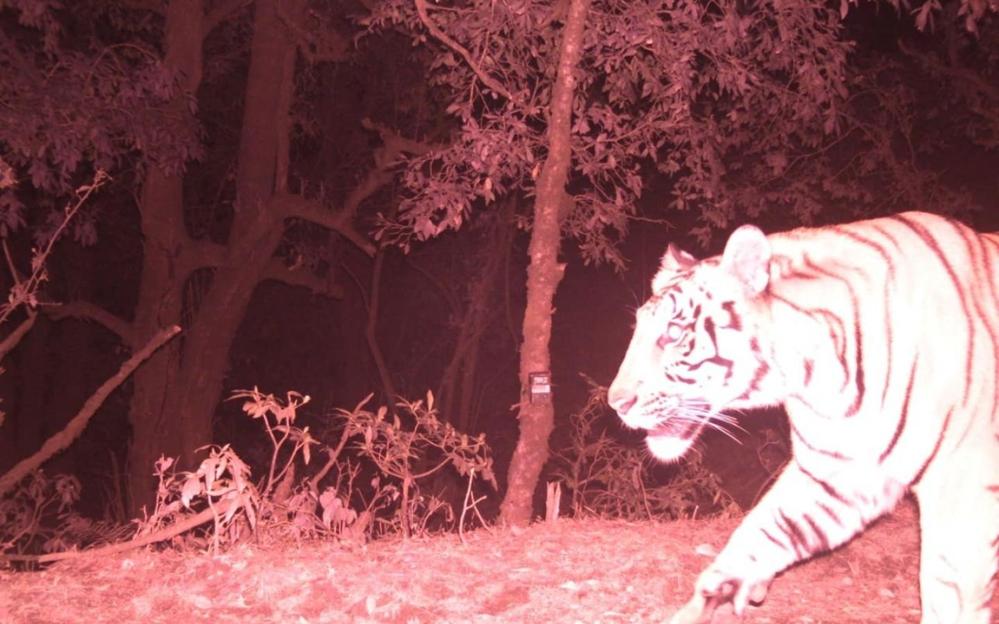
This extraordinary discovery greatly expands the research field within the project to repopulate tigers' natural habitats. First, WWF can now confirm that tigers can exist in high mountains—something never before proven. The zone thus appears suited to the animal's natural needs for feeding and reproduction.
The animal's own adaptation is equally well confirmed by this photograph. This image now demonstrates that the big cat managed to find a new habitat for itself under conditions totally different from those it had previously known.
Frequently asked questions
WWF photographed a tiger at 2,500 meters altitude in the Mahabharat mountain range in central Nepal. The infrared camera traps were installed between 1,600 and 2,500 meters altitude across a 130 square-kilometer zone.
In 2010, the global wild tiger population was estimated at 3,200 individuals. Thanks to conservation efforts, particularly WWF's Tiger x2 project, this population has risen to approximately 3,890 individuals. WWF's goal is to reach 6,000 wild tigers by 2022.
Over 100 years, the tiger population has declined by 95%. The main threats are intensive poaching (for organs used in traditional medicine or as status symbols) and the destruction and fragmentation of their natural habitat, which prevents individuals from encountering and reproducing with one another.
Launched in 2010, WWF's Tiger x2 project aims to double the global wild tiger population, from 3,200 to 6,000 individuals by 2022. To accomplish this, the organization has installed infrared camera traps in all tiger habitat countries to monitor the species' evolution.
Yes, the discovery made by WWF in Nepal confirms this for the first time. Historically confined to lowland plains and forests, a tiger was photographed at 2,500 meters altitude in the Mahabharat range, proving that the animal can adapt to high mountain conditions.