Kirtipur
Kirtipur
An ancient Newari fortress perched southwest of Kathmandu, Kirtipur retains its temples, cobbled streets and a rare village atmosphere in the valley.
An ancient fortified Newari city perched on a ridge to the southwest of the valley, Kirtipur preserves the character of a medieval town with its cobbled streets, its red-brick temples and squares where rice and chillies still dry in the sun. Long overshadowed by its neighbour Kathmandu, it now offers a rare glimpse of Newari culture preserved from the major tourist flows.
Why visit Kirtipur
Kirtipur condenses in one compact site several facets of the valley's heritage: traditional Newari architecture, living temples, village atmosphere and clear viewpoints over the Kathmandu valley. Unlike the heavily visited durbar squares, the city remains inhabited by a predominantly Newari population that perpetuates weaving, pottery and religious festivals. For travellers seeking direct contact with local life and a half-day away from the beaten path, Kirtipur makes a coherent stop from the capital.
History: a Newari fortress marked by the 1767 siege
Founded in the 12th century as an outpost of the Patan principality, Kirtipur — whose name means "the glorious city" in Sanskrit — was one of the Newari city-states of the valley before Nepal's unification. Its elevated position made it a formidable stronghold.
The most dramatic episode in its history is the siege led by Prithvi Narayan Shah, king of Gorkha, completed in 1767. After several unsuccessful attempts and the loss of one of his closest associates, the sovereign finally seized the city. According to chronicles of the time, he ordered in reprisal the mutilation of the noses and lips of male inhabitants, with the exception of wind instrument players. This episode, attested by several historical sources, marks the turning point of the valley's conquest by the Shah dynasty and the end of Newari autonomy.
Today, the urban layout preserves this defensive logic: narrow lanes, steep staircases, houses clustered around small chowks (courtyards).
What to see in Kirtipur
Bagh Bhairav Temple
At the heart of the city, Bagh Bhairav temple is dedicated to the "tiger god", guardian of Kirtipur. Listed as a Historical Monument, the multi-tiered roof edifice is one of the most active temples in the valley. Its facade is adorned with swords and shields offered by the Newari soldiers defeated in 1767, transformed into ex-voto offerings. Animal sacrifices are still practised there during certain celebrations.
Uma Maheshvara Temple
Perched on the highest point of the city, Uma Maheshvara temple is reached by a stone staircase guarded by two elephant statues. Dedicated to Shiva and Parvati, it offers a panorama over the Kathmandu valley and, on clear days, over the Ganesh Himal range. A small sanctuary to Ganesh also occupies the site.
Chilancho Stupa
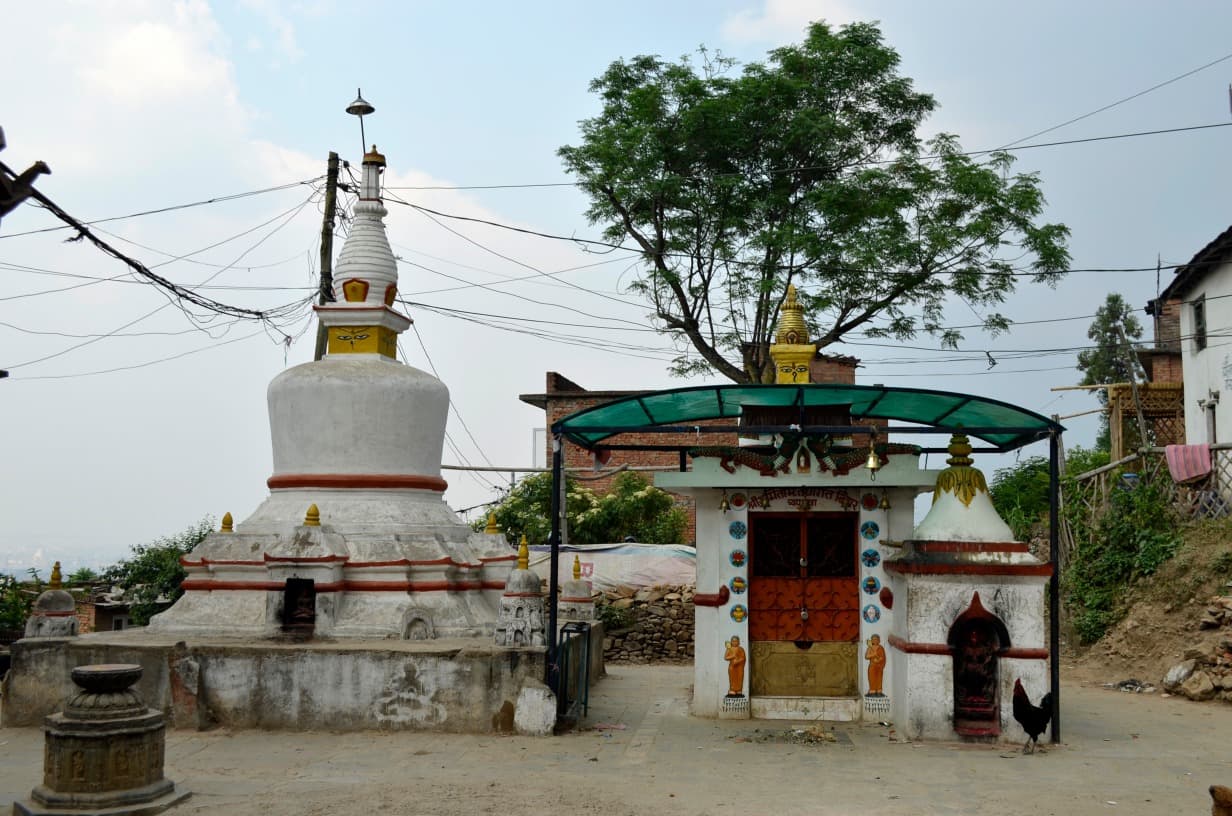
At the other end of the ridge, this 15th-century Buddhist stupa, surrounded by four smaller stupas, recalls the coexistence of Hinduism and Newari Buddhism characteristic of the valley.
The Old Town
Beyond the monuments, a stroll through the lanes is the main attraction: brick houses with carved wooden windows, dhaka weaving workshops (traditional fabric), small courtyards where family rituals are organised. The upper section, around Bagh Bhairav, is the best preserved.
Practical information
- Duration of visit: allow 2 to 3 hours to walk around the upper and lower city.
- Admission: access to the town is free; some temples may request a symbolic contribution.
- Etiquette: remove your shoes before entering sanctuaries, do not photograph rituals without permission, walk around stupas and chaityas on the left (clockwise direction).
- What to bring: comfortable shoes (stairs, uneven paving), water, and a light jumper in winter as the city is exposed to the wind.
How to get there
Kirtipur is located approximately 6 kilometres southwest of the centre of Kathmandu, on the road to Tribhuvan University.
- By taxi from Thamel or Durbar Marg: a journey of around thirty minutes depending on traffic, the simplest option.
- By local bus: minibuses leave regularly from Ratna Park towards Kirtipur, an economical but less comfortable option.
- On foot or by bike from the Tribhuvan University campus, accessible to travellers already based in the south of the valley.
When to go
The dry season, from October to March, offers the best conditions: clear skies, mild temperatures and maximum visibility of the Himalayas from Uma Maheshvara temple. Avoid the monsoon (June to September), when the cobbled streets become slippery and visibility is nil.
The Bagh Bhairav festival, celebrated in autumn (generally in October-November according to the lunar calendar), features processions and offerings that enliven the entire city. This is a privileged time to discover Kirtipur in full ritual life, provided you accept the local crowds.
Combine with Kirtipur
Kirtipur's proximity to other Newari sites makes it possible to build an itinerary of a day or two in the south of the valley:
- Bungamati, a Newari village devoted to woodcarving, about ten kilometres to the south.
- Bhaktapur Durbar Square, to extend your immersion in Newari architecture on a larger scale.
- Changu Narayan, the oldest Hindu temple in the valley.
- Chobar and Champa Devi hill, accessible from Kirtipur for a half-day hike.
Include Kirtipur in your trip
A discreet but historically rich stop, Kirtipur integrates easily into a stay in the Kathmandu valley, complementing the major sites. Our advisors build tailor-made itineraries incorporating these Newari villages often overlooked by conventional circuits. Discover our Nepal trips to plan your stay.
Nearby
Interested in this visit?
We can include it in your personalised itinerary.