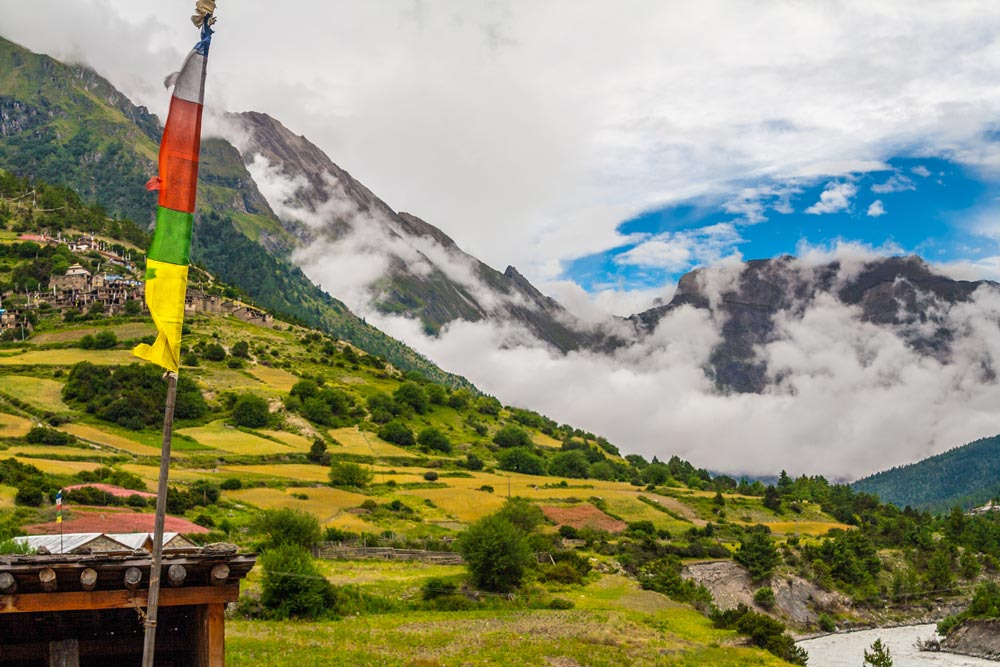
Philim
Philim is the waypoint village marking the entrance to Tsum Valley in Gorkha district. Stone architecture, mani walls, and intact Tibetan Buddhist culture make it a memorable stop on this restricted-area trek.
Philim is a village in Tsum Valley, located in Gorkha district in northern Nepal. Situated at the entrance of this remote valley, it marks the first significant village encountered on the Tsum Valley trek. Populated predominantly by Tsumbas, a people of Tibetan origin, Philim preserves a Himalayan Buddhist culture largely untouched by mass tourism.
What to see
Philim spreads across a plateau above the Budhi Gandaki River. The village clusters stone houses with flat roofs, typical of Himalayan architecture. Prayer mills, chortens, and mani walls line the narrow paths. Terraced fields of barley and buckwheat frame the village.
History and context
Tsum Valley was long forbidden to outsiders. It only opened to trekking in 2008, which explains the remarkable preservation of its traditions. As the first significant village in the valley, Philim serves as a waypoint and resupply hub for trekkers. The local population practices Tibetan Buddhism and maintains close cultural ties with neighboring Tibet.
Highlights of your visit
Village architecture
Two-story stone houses with flat roofs serving as drying areas exemplify adaptation to high-altitude climate. Facades are often adorned with painted Buddhist symbols.
Mani walls
Long walls of stones carved with Buddhist mantras border the paths around the village. Local custom dictates passing them on the left, in a clockwise direction.
Local market
Philim has a few small shops and lodges that supply trekkers before their journey into the higher valley. It's one of the last resupply points before reaching more isolated villages.
Etiquette and visit guidelines
- Mani walls and chortens: always pass them on the left (clockwise direction).
- Places of worship: remove your shoes before entering a monastery or gompa.
- Photography: ask permission before photographing residents or the interiors of religious sites.
- Required permits: Tsum Valley requires a special Restricted Area Permit as well as a Manaslu National Park permit. These documents must be obtained before departure.
Photography tips
Morning light illuminates the stone facades and terraces from the east. Mani walls and chortens make interesting foregrounds with mountains as your backdrop. Avoid photographing religious ceremonies without explicit permission.
Location and access
Philim lies in Tsum Valley, accessible from Arughat or Soti Khola, the usual starting points for the Tsum Valley / Manaslu trek. The trail follows the Budhi Gandaki northward. There is no motorable road to Philim; access is on foot only. From Kathmandu, a vehicle journey to Arughat or Machha Khola precedes several days of hiking.
The Tsum Valley trek requires restricted-area permits, which must be obtained through an authorized Nepali trekking agency.
Nearby attractions
- Tsum Valley — sacred Buddhist valley extending north of Philim, toward Tibet.
- Rachen Gompa — nunnery monastery further upstream in Tsum Valley.
- Mu Gompa — one of the valley's largest monasteries, perched at high altitude.
- Manaslu — the world's eighth highest mountain, visible from several points along the trek.
- Arughat — the trek's starting town, accessible by vehicle from Kathmandu.
Frequently asked questions
Yes. Tsum Valley is a restricted area. You must obtain a Restricted Area Permit as well as a Manaslu National Park permit, available only through an authorized Nepali trekking agency.
The most favorable seasons are spring (March–May) and autumn (September–November), when monsoon rains and snowfall are limited.
From Soti Khola or Machha Khola, plan for two to three days of hiking, depending on your pace and chosen starting point.
Yes, Philim has several basic trekking lodges offering accommodation and meals. Comfort remains simple, suited to high-mountain conditions.
Yes. The Tsum Valley trek is often combined with the Manaslu Circuit, as both routes share part of their path along the Budhi Gandaki.
Want to discover this destination?
Our local advisors design your tailor-made trip.