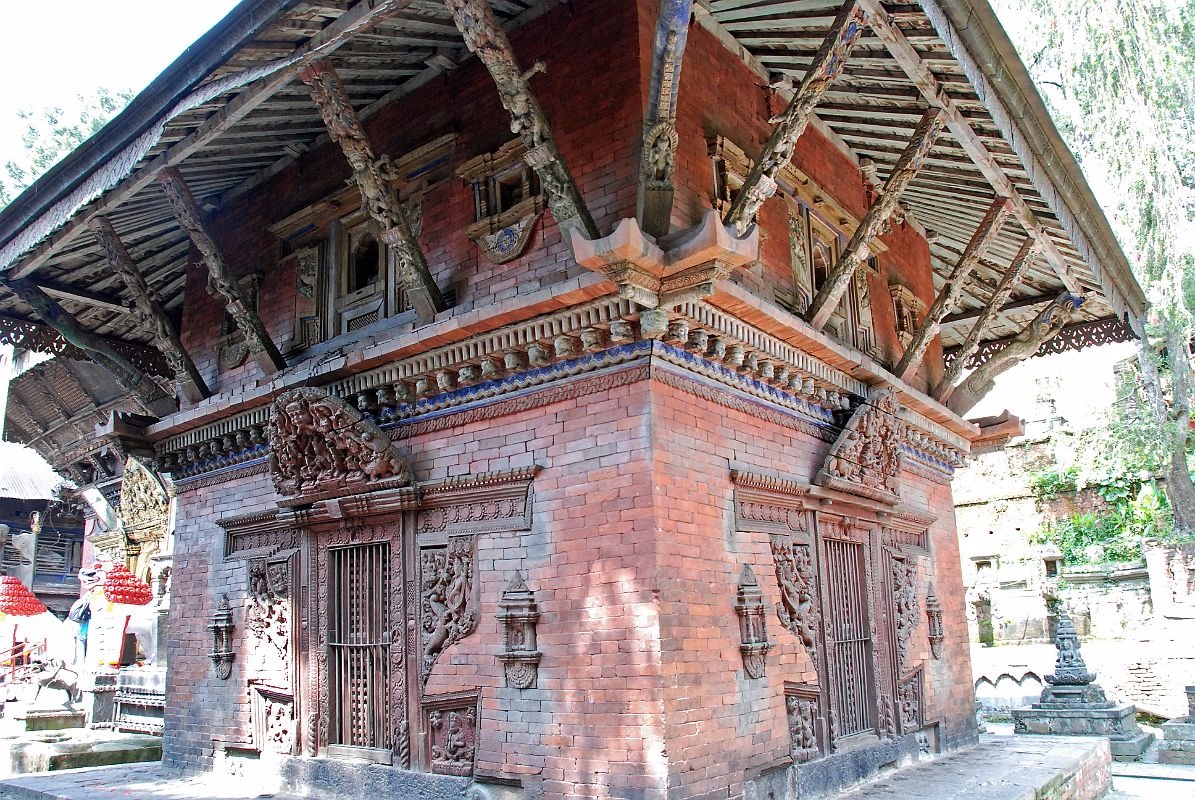
Panauti
Located 32 km from Kathmandu, Panauti is a medieval Newar city spared by earthquakes. Its Indreshwar Mahadev temple, red-brick lanes, and ghats at the sacred confluence make it an authentic stop away from mass tourism.
Panauti is a medieval Newar city situated some thirty kilometers southeast of Kathmandu, at the confluence of the Punyamati and Roshi rivers. Spared by the major earthquakes that devastated the valley, it preserves an urban fabric from the Malla period that is remarkably intact: tiered-roof temples, paved courtyards, and red-brick houses with carved details. It is one of the few cities in Nepal where traditional Newar architecture survives at the scale of an entire district.
Essential information at a glance
- Access from Kathmandu: local buses or taxis from Banepa (approximately 6 km); Banepa is accessible by bus from Koteshwor bus station.
- Recommended duration: half a day is sufficient for the historic center; a full day to explore peripheral temples.
- Admission: the city is freely accessible; some temples may request a small donation.
- Dress code: covered clothing recommended for entering temple courtyards.
What to see
The heart of Panauti is organized around the Khware, the sacred confluence of the two rivers, bordered by ghats and small sanctuaries. The temple of Indreshwar Mahadev, dedicated to Shiva, is the most imposing monument: its three-tiered structure dates from the fourteenth century and its wooden beams bear erotic and mythological sculptures of remarkable finesse. Brahmayani Square houses a second major temple dedicated to the goddess Brahmayani. The lanes of the old quarter reveal chowks (courtyards) adorned with latticed wooden windows and small neighborhood shrines.
History and context
Panauti is mentioned in Newar chronicles as early as the twelfth century. It flourished under the Malla dynasty, which unified the Kathmandu valley between the thirteenth and seventeenth centuries. Its position at the crossroads of trade routes connecting the valley to Tibet gave it considerable economic and religious importance. Unlike Bhaktapur or Kathmandu, it escaped destruction from successive wars and earthquakes, which explains the exceptional state of preservation of its historic center.
Highlights of your visit
Indreshwar Mahadev Temple
Considered one of Nepal's oldest multi-tiered temples, it stands out for the quality of its carved woodwork. The wooden panels depict deities, scenes from the Ramayana, and erotic figures characteristic of Malla art. The interior is reserved for Hindus.
The Khware confluence
This junction point of the rivers is considered particularly auspicious for funeral rites and ritual bathing. Stone ghats allow access down to the water. The atmosphere is contemplative, especially early in the morning.
Newar lanes
Getting lost in the narrow lanes of the old quarter is an experience in itself. The two- or three-story brick houses, with their ornately carved wooden windows, are still inhabited. A few artisans work with wood and metal in workshops open to the street.
Mahadev Pokhari
This sacred basin on the periphery of the center is surrounded by small temples and votive sculptures. It offers a peaceful setting, away from the main thoroughfares.
Etiquette and visiting guidelines
- Remove your shoes before entering temple courtyards.
- Access to the inner sanctum of Hindu temples is generally reserved for Hindu devotees.
- Ask permission before photographing people at prayer or during funeral rites at the ghats.
- Dress modestly with shoulders and knees covered.
Photography tips
Morning light is ideal for photographing red-brick facades without backlighting. The carved woodwork of Indreshwar Mahadev is best seen in diffuse light (slightly overcast sky). Narrow lanes create interesting shadow play mid-morning. Avoid using flash inside temple courtyards.
Location and access
Panauti is located in Kavrepalanchok district, approximately 32 km southeast of Kathmandu via the Banepa road. The town of Banepa, 6 km away, is the nearest transport hub. From Kathmandu, local buses serve Banepa from Koteshwor; from there, tempo (motorized tricycles) or taxis connect to Panauti. The road is paved and accessible by car. Panauti is often combined with Bhaktapur or Namobuddha in a day excursion from the capital.
Nearby attractions
- Bhaktapur — The great medieval Newar city of the valley, approximately 20 km away, with its UNESCO-listed Durbar Square.
- Namobuddha — A Tibetan Buddhist monastery perched on a hillside, about fifteen kilometers away, accessible on foot or by vehicle.
- Banepa — A commercial transit town with the Chandeshwari temple, the region's protective goddess.
Frequently asked questions
The dry season, from October to April, offers the best conditions. Autumn (October–November) combines clear skies with pleasant temperatures. Avoid the monsoon (June–September) due to slippery roads and ghats.
Yes, this is a common combination. Start with Panauti in the morning (2–3 hours suffice for the historic center), then head to Bhaktapur in the afternoon. A private vehicle offers greater flexibility.
The city is easily explored on your own: the historic center is compact and major temples are visible from the lanes. A local English-speaking guide provides useful insight into the iconography of sculptures and Malla history.
The outer courtyards and squares are accessible to all. Access to the inner sanctum of Hindu temples such as Indreshwar Mahadev is generally reserved for Hindu devotees.
The dining scene remains modest: a few small local restaurants serve dal bhat and Newar snacks. For a wider selection, Banepa is just a few kilometers away.
Want to discover this destination?
Our local advisors design your tailor-made trip.