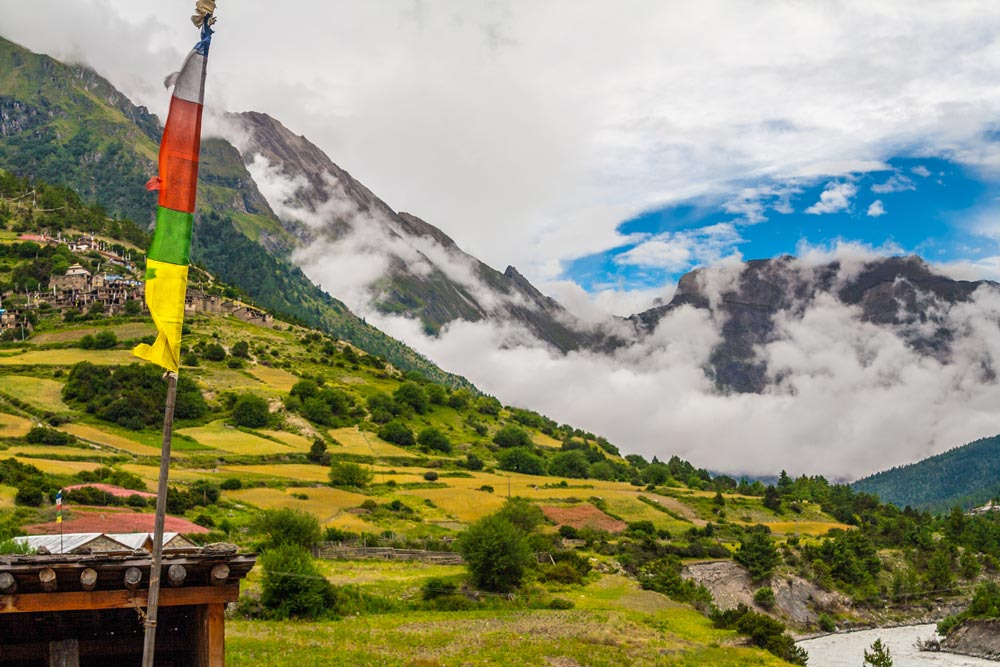
Dharapani
Dharapani is a pivotal stop on the Annapurna Circuit, situated at 1,860 m altitude, where the trail enters the protected ACAP zone. A Tibetan-style village and junction to Tsum Valley, it offers authentic tea house atmosphere.
Dharapani is a mountain village located in the Marsyangdi Valley at the beginning of Manang District, on the Annapurna Circuit. Positioned at approximately 1,860 metres altitude, it marks the point where the trail leaves the open zone and enters the restricted area of the circuit. It is a transitional stage: the landscape shifts, vegetation becomes denser, and snow-capped peaks begin to dominate the horizon.
Practical Information at a Glance
- Altitude: approximately 1,860 m
- Access: vehicle track from Besisahar; accessible by jeep or on foot from Jagat
- Permit required: ACAP (Annapurna Conservation Area Permit) and TIMS card mandatory before entering the zone
- Recommended duration: one-night stage on the Annapurna Circuit
- Accommodation: tea houses available in the village
What You'll See
Dharapani is a Tibetan-style village, with stone houses, prayer wheels, and colourful prayer flags. The Marsyangdi flows below in a narrow gorge. The village offers direct views of the first rock faces of Manang District and visually marks entry into wilder, more arid territory.
History and Context
Dharapani sits at the junction of two valleys: the Marsyangdi and the route leading to Tsum Valley via Thonje. Historically, this crossroads made it a commercial passage point between the Tibetan highlands and the Nepalese plains. Tibetan cultural influence is evident in local architecture and the Buddhist religious practices of its inhabitants.
Highlights of Your Visit
The Restricted Zone Checkpoint
At Dharapani, ACAP rangers verify permits. It is a concrete moment marking your passage into a protected zone. Have your documents ready before reaching the checkpoint.
The Confluence of Valleys
The village is positioned at the confluence of two valleys. Looking northward, the Dudh Khola valley opens towards Tsum Valley, a destination still little frequented. This crossroads gives a sense of the region's geographical complexity.
The Tea House Atmosphere
Lodges in Dharapani serve simple Nepali and Tibetan cuisine: dal bhat, thukpa, momos. After a day's trek from Jagat or Tal, the stage is appreciated for its relative calm compared to more touristy villages on the circuit.
Photography Tips
Morning light illuminates the rock faces to the north of the village. Prayer flags on suspension bridges offer colourful foregrounds with mountains in the background. Avoid midday, often hazy during the monsoon season.
Location and Access
Dharapani lies on the Annapurna Circuit, between Tal (downstream) and Bagarchhap (upstream). The vehicle track from Besisahar makes it accessible by jeep, which sometimes makes it an alternative starting point for trekkers wishing to avoid the motorised early stages of the circuit. The village is approximately one day's trek from Chame, the administrative capital of Manang District.
Nearby Attractions
- Bagarchhap — the first Tibetan-style village marked on the circuit, featuring a Buddhist monastery and characteristic stone architecture.
- Tal — a downstream village situated in an ancient lakebед, surrounded by waterfalls and impressive cliff faces.
- Chame — administrative capital of Manang District, with banking services, trekking agencies, and views of Annapurna II.
- Tsum Valley — a remote valley accessible from Thonje, near Dharapani, renowned for its monasteries and Tibetan cultural isolation.
Frequently asked questions
Yes. The ACAP (Annapurna Conservation Area Permit) and TIMS card are mandatory. The Dharapani checkpoint verifies these documents. Obtain your permits in Kathmandu or Pokhara before departing.
The optimal seasons are autumn (October–November) and spring (March–May). In winter, snow can block the passes upstream. The monsoon (June–September) makes trails slippery and visibility poor.
Yes, a vehicle track connects Besisahar to Dharapani and beyond. Jeeps operate this route, allowing you to start trekking directly from the village if you wish to skip the motorised early stages.
The neighbouring village of Thonje, a few kilometres away, is the true junction for Tsum Valley. Dharapani serves as a logistical stage before this deviation. Tsum Valley requires an additional restricted-zone permit.
Layered clothing is essential: temperatures drop at night even in favourable seasons. Bring waterproof trekking shoes and lightweight rain gear.
Want to discover this destination?
Our local advisors design your tailor-made trip.