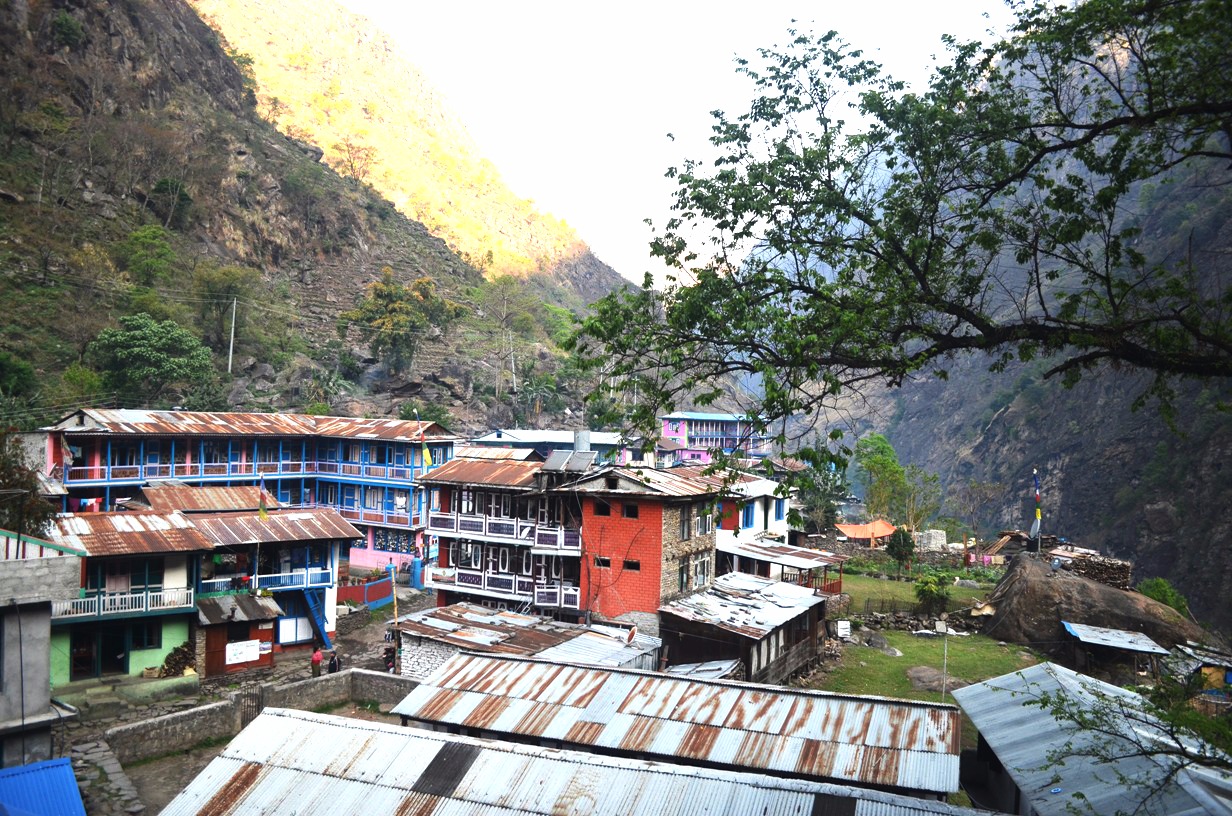
Birethanti
Mountain village at 1,025 m elevation, Birethanti marks the official entrance to the Annapurna Conservation Area. Suspended bridge, river confluence and ACAP checkpoint make it the essential first stop on treks in the region.
Birethanti is a mountain village nestled at the confluence of the Modi Khola and Bhurungdi Khola rivers, in the Annapurna region of Nepal. The official gateway to the Annapurna Circuit and Annapurna Sanctuary, it marks the beginning of the trek for thousands of hikers each year. The village retains an authentic low-altitude atmosphere, with its stone houses, cultivated terraces and first glimpses of the Himalayan foothills.
Quick reference information
- Access: from Pokhara by taxi or local bus to Nayapul (road starting point), then 20-30 minutes on foot to Birethanti
- Formalities: TIMS (Trekkers' Information Management System) and ACAP permit (Annapurna Conservation Area Project) required — to be obtained in Pokhara or at Birethanti's checkpoint
- Altitude: approximately 1,025 m
- Recommended duration: half-day to one-night stage depending on trek itinerary
- Accommodation: several teahouses (trek lodges) available in the village
What to see
The village sprawls across both banks of Modi Khola, connected by a suspended bridge. Paved alleyways wind past traditional stone houses and terraced gardens. A small Hindu temple marks the heart of the village. Vegetation remains lush at this altitude: rhododendrons, banana plants and rice paddies frame the first steps of the trek.
History and context
Birethanti long served as a commercial halt on mountain routes linking Pokhara to remote villages in the Annapurna region. With the boom in trekking during the 1970s-1980s, the village gradually transformed into a logistical starting point. The creation of ACAP in 1986 structured the management of visitor flow, with its main checkpoint installed here.
Highlights of the visit
The ACAP checkpoint
This is where permits are validated before entering the conservation area. Staff can provide information on trail conditions and current weather.
The river confluence
The meeting point of Modi Khola and Bhurungdi Khola offers a striking setting: turquoise waters, rocky banks and dense forest in the background. A natural stopping point before ascending.
The suspended bridge
Crossing the suspended bridge above Modi Khola is often the first striking experience of the trek. It connects both sides of the village and gives your first sense of the vastness of the landscape that awaits higher up.
Photography tips
Morning light is ideal for photographing the suspended bridge and river, before valley mist rises. The cultivated terraces below the village are photogenic during the monsoon season (June-September) when rice is green. Avoid backlighting in late afternoon on the western bank.
Location and access
Birethanti lies about 42 km west of Pokhara by road. The journey by taxi or local bus to Nayapul takes around one hour depending on traffic. From Nayapul, a flat path follows the river to the village. The ACAP checkpoint is the first official building encountered upon arrival. Wheelchair accessibility is limited due to uneven terrain and stone stairs.
Nearby attractions
- Nayapul — road starting point, a few kilometers downstream, terminus for transport from Pokhara.
- Tikhedhunga — classic first stage of the Annapurna Circuit after Birethanti, known for its famous stone stairs.
- Ghandruk — large Gurung village at altitude, accessible in one day's walk, with direct views of Annapurna South and Machhapuchhre.
- Pokhara — main logistical base for Annapurna treks, about one hour by road.
Frequently asked questions
Yes. TIMS and ACAP permits are required. They can be obtained in Pokhara (tourism office or trek agencies) or directly at Birethanti's checkpoint. Bring ID photos and cash.
Ideal seasons are autumn (October-November) for clear air and spring (March-April) for rhododendrons in bloom. The monsoon (June-September) makes trails slippery but vegetation is lush.
Yes, several teahouses offer accommodation and meals. This is a convenient option if you arrive late from Pokhara and want to start the trek early the next morning.
The village itself is accessible to everyone. The treks departing from here vary in difficulty: the climb to Ghandruk is demanding (significant elevation gain), while the first few kilometers along the river remain moderate.
The classic combination is Pokhara–Birethanti–Ghandruk over two days, with return via Nayapul. For a longer circuit, Birethanti is the starting point of the full Annapurna Circuit via Tikhedhunga and Ulleri.
Want to discover this destination?
Our local advisors design your tailor-made trip.