The Nepalese Armed Forces
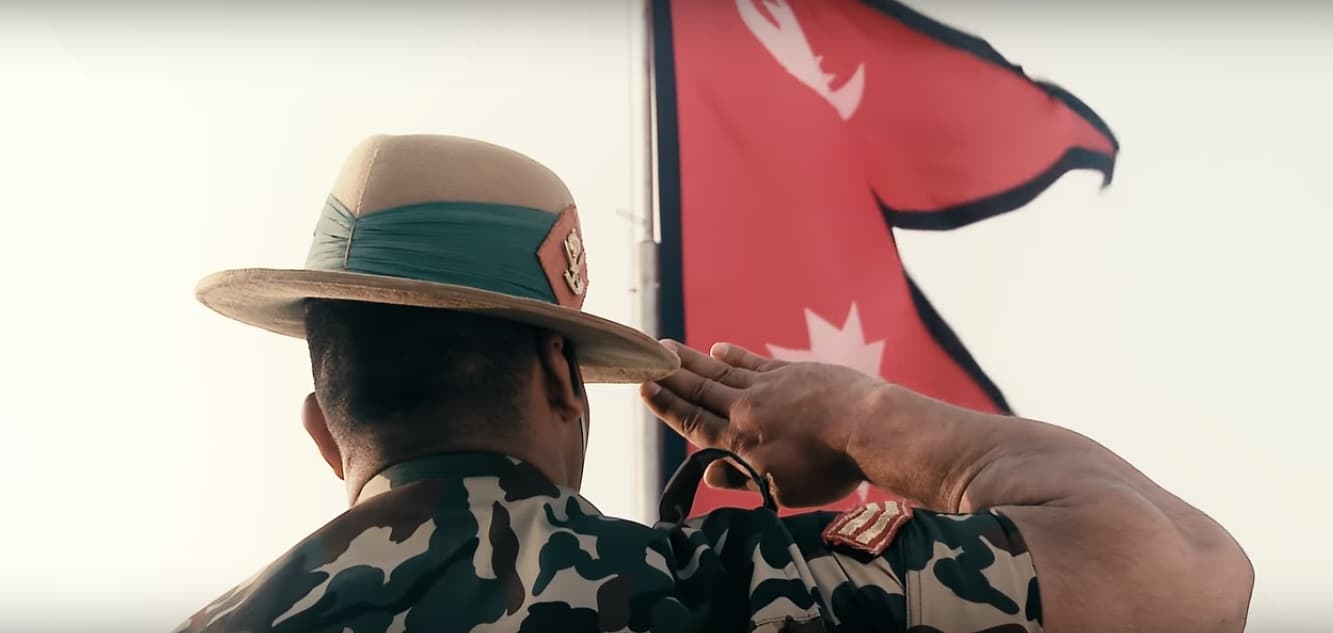
The Nepalese armed forces are divided into 2 main branches: the army and the air force.
The Nepalese armed forces are divided into 2 main branches: the army and the air force. Criticized for its violence and numerous human rights violations during the Maoist revolution in the early 2000s, it today attracts an increasing number of young people for its stability and career prospects.
History
The Nepalese army truly took shape during the 18th century through numerous battles for the country's unification. The first major conflicts occurred in the 19th century against the British East India Company. British expansion in the region left no choice but war between the two belligerents. Superior in numbers (34,000 against 12,000 soldiers), the war ended in a British victory in 1816 and the Treaty of Titalia. Through this treaty, Nepal lost nearly half of its territory. The second war took place in India in 1857.  At that time, India was under the control of the British East India Company, an enterprise that held a monopoly on all trade across the Indian Ocean. A portion of the army and civilians rebelled to protest against this monopoly. The war, which lasted just over a year, ended in a British victory with assistance from the Nepalese royal army. By aiding the British, Nepalis ensured stable diplomatic relations while also being able to plunder their neighbor's resources. World War I witnessed numerous Nepalese casualties. Nepal sent nearly 7,500 soldiers of the royal army to India. Beyond these 7,500, many Nepalis (over 20,000) fought under the British Crown by joining the Gurkha contingents, British military units recruited in Nepal. After several interventions, notably in Afghanistan under British direction, Nepal officially declared war on Germany in 1939. During the war, most soldiers of the Nepalese royal army joined the Burmese front against Japanese troops. Other conflicts occurred until the end of the 20th century. The most recent was the Maoist insurgency between 1996 and 2006. Initially in rural areas, a Maoist movement gradually took shape and contested the monarchy. The assassination of the royal family in 2001 during dinner by, officially, the prince (who committed suicide immediately afterward), left only one successor: the king's brother (who was the only one absent from the dinner). The assassination and conspiracy theories pushed the protest movement into the cities. After 10 years of civil war and over 10,000 deaths, an agreement was reached. The king stepped down, the Maoists joined the government, and a republic was established.
Its Components
Nepal has several security forces:
The Army and Air Force
For its defense, the new republic spent nearly $360 million in 2017. Excluding the police and paramilitary militia, the country employs 95,000 active personnel and has 60,000 reserves. Nearly all its equipment comes from abroad—primarily India, which supplies both logistical equipment and ammunition, but also other major powers such as the United States (which provided 20,000 M16 rifles), China, and Belgium. The country possesses approximately 140,000 combat rifles. It also maintains a fleet of just under 200 combat vehicles: 40 British Daimler Ferrets, 37 South African Casspir MRAPs, 124 Indian Adityás, 5 Chinese WZ551s, and 8 Czechoslovak OT64s. The air force employs only 500 people. It operates a small fleet of about thirty aircraft, including 2 Soviet MI-17s and 2 Indian Hal Dhruv helicopters. 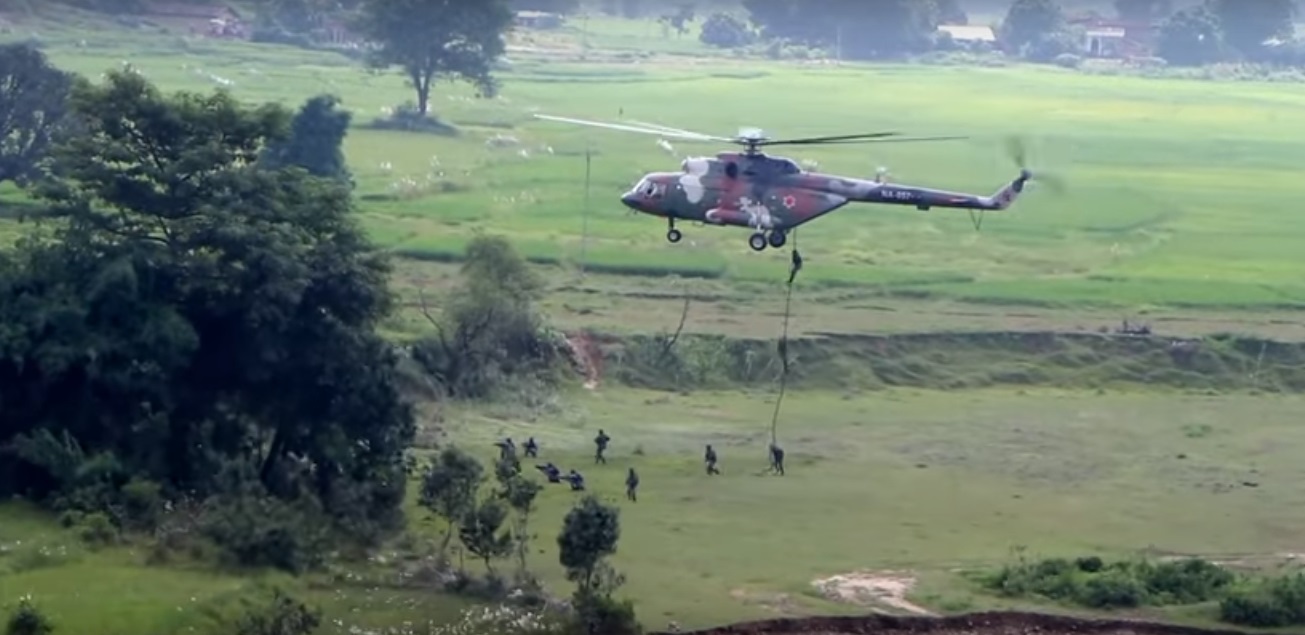
Armed Police Forces (Paramilitary)
It counted 40,000 members as of 2015. These paramilitary forces are organized as combat brigades. This force has existed since 2001 to assist the police and regular army in their fight against Maoist rebels.
The Police
The Nepalese police force consists of a total of 67,416 members, 2,344 permanent offices, and 507 temporary posts distributed throughout the country. Police officers generally carry no handguns. In certain sensitive zones, officers are equipped with batons, shotguns, or Israeli Galils. 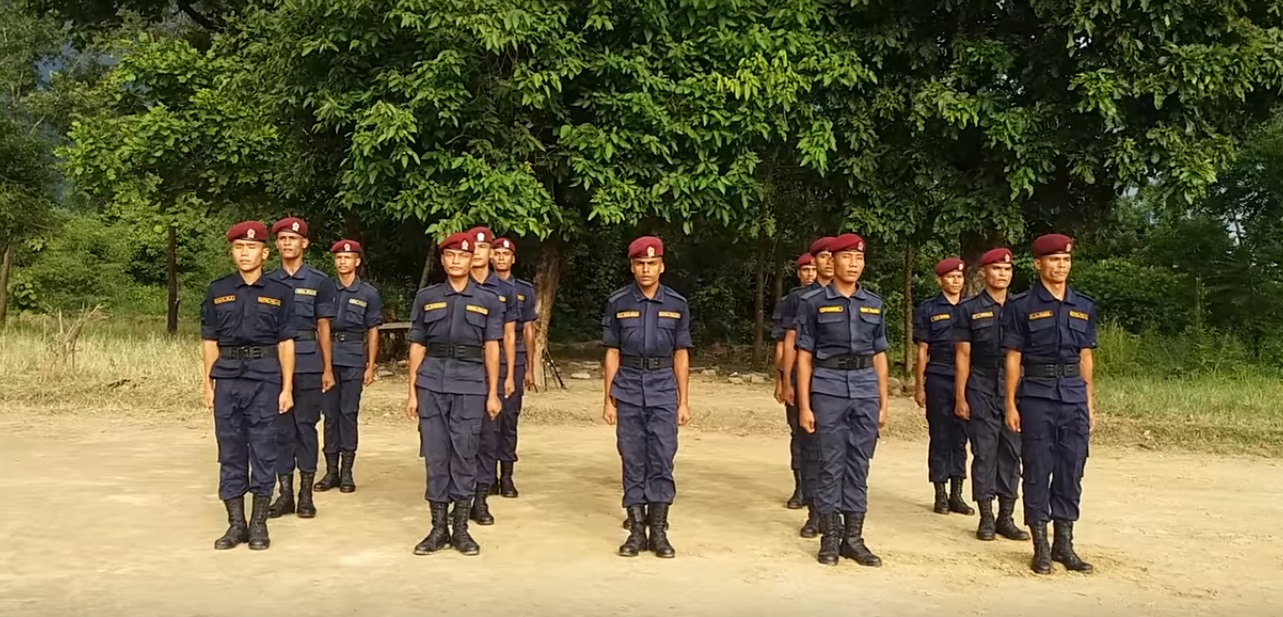
Military Cooperation
USA: Since September 2001, in the name of combating terrorism, Nepal has maintained good diplomatic relations with the United States. Nepalese officers are trained annually at the US Army War College in Pennsylvania and at the Command and General Staff College in Kansas. In March 2017, Nepal, the United States, and 28 other countries launched joint military exercises (Shanti Prayas III) on Nepalese territory. India: Since 2001, India has maintained excellent relations with Nepal. The former king, wishing for independence from India, leads many Nepalis to believe that Indian intelligence services are responsible for the massacre of the Nepalese royal family in 2001. China: With China's ambitious "Belt and Road Initiative," Nepal launched a seduction campaign to benefit from Chinese investments. The two nations signed several agreements, and in April 2017, the first Sino-Nepalese military exercises were held in Kathmandu. This marks proof of new cooperation, viewed unfavorably by New Delhi.
Foreign Operations
Besides joint military exercises with China and India, Nepal has participated in numerous missions under UN direction. These include operations on the Golan Heights to oversee the ceasefire between Syria and Israel, peacekeeping operations in Haiti in 2017 with the deployment of 1,243 police and military personnel, and surveillance operations on the Israeli-Lebanese border with the deployment of 850 soldiers. Today, new missions are entrusted to the Nepalese army, such as fighting poaching, notably in Chitwan National Park. 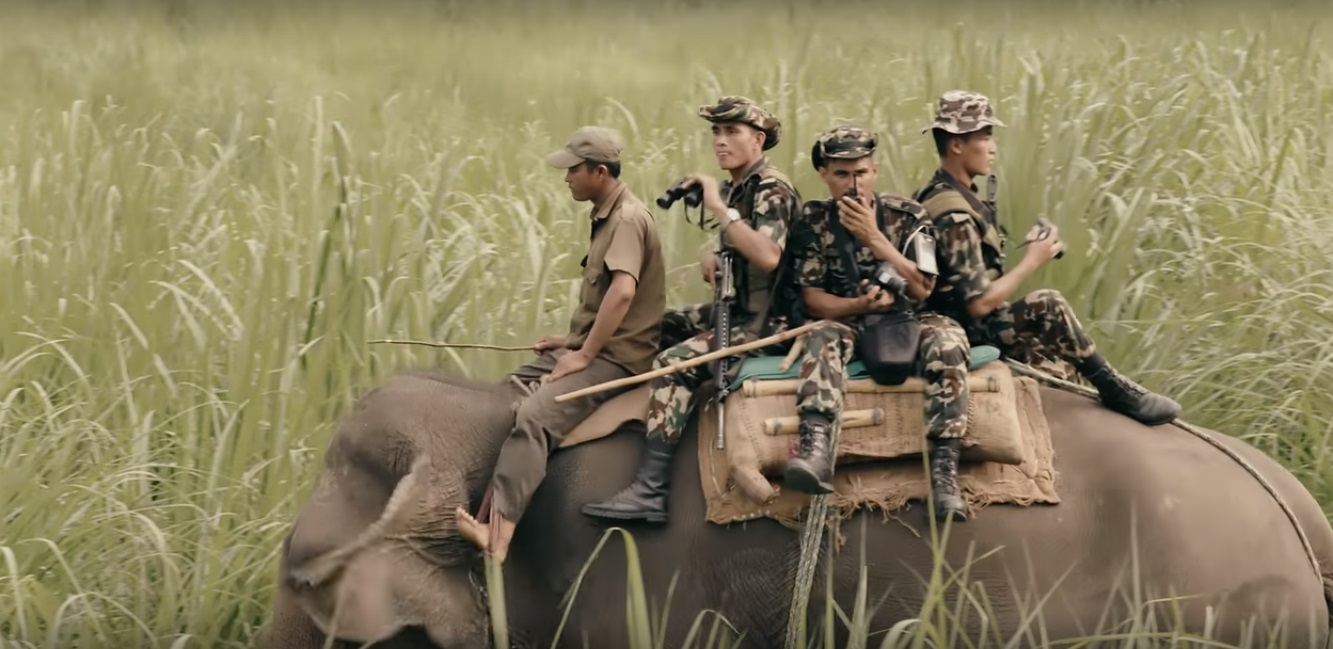
Frequently asked questions
The Nepalese armed forces comprise approximately 95,000 active military personnel and 60,000 reserves. Additionally, there are 40,000 members of paramilitary forces and over 67,000 police officers distributed across the country.
The Gurkhas are Nepalese soldiers recruited to serve in British and Indian military units. They form distinct contingents from the Nepalese royal army, but represent an emblematic national pride of Nepal.
In 2017, Nepal allocated approximately $360 million to its defense. Nearly all of its military equipment is imported, notably from India, the United States, China, and Belgium.
Yes, Nepal is an active contributor to UN missions. It has notably participated in peacekeeping operations in Haiti (1,243 soldiers in 2017), on the Golan Heights between Syria and Israel, and on the Israeli-Lebanese border (850 soldiers).
The Nepalese army took shape during the 18th century through wars of national unification. It subsequently faced the British East India Company in the 19th century, participated in both world wars, and later fought the Maoist insurgency between 1996 and 2006, a conflict that resulted in the end of the monarchy.