Religions
Religion is one of the most important values in Nepal. Culture, architecture, food—everything has a close or distant connection to a religious concept. Since 2006, the country has been considered secular and treats all types of religions equally in a peace unique in the world.
Religion is one of the most important values in Nepal. Culture, architecture, food—everything has a close or distant connection to a religious concept. Since 2006, the country has been considered secular and treats all types of religions equally in a peace unique in the world.
Hinduism, the Majority Religion
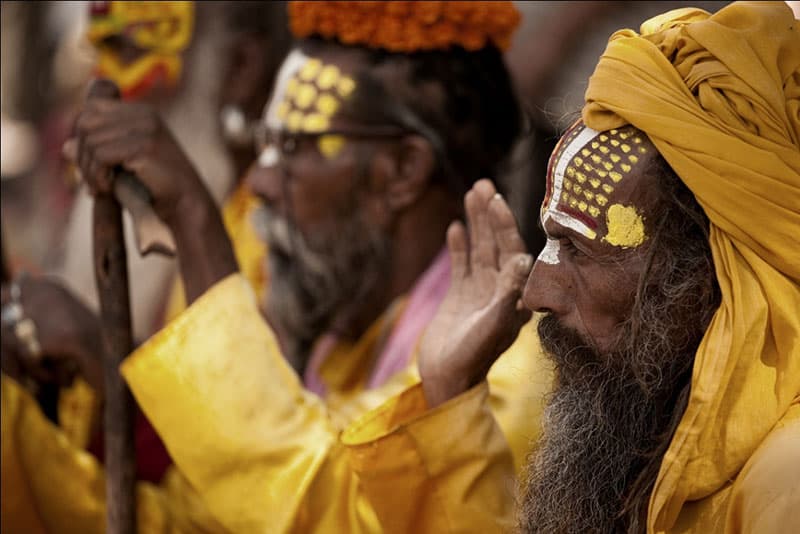
Nepalis are predominantly Hindu, accounting for nearly 80% of the population, which explains the cows you'll often see wandering through the streets, avoided by cars and pedestrians alike. Beyond that, numerous temples dedicated to the principal Hindu deities are scattered throughout the country, and images of these gods are displayed everywhere—from offices to private homes, even in public transportation. You'll need to know at least the three main ones: Brahma represents creation, Vishnu protection, and Shiva destruction and transformation. Many others exist alongside them, and the list is nearly endless. Religion is scrupulously respected, and it's common to see Nepalis pause to offer a brief prayer before a temple, idol, or sacred object before continuing on their way. You should be careful and ask around before taking photographs or even approaching certain religious buildings, whose sacred nature makes them off-limits to non-believers. Finally, one of Hinduism's fundamental principles is the concept of karma: good or bad actions influence the conditions of life during reincarnation. It's therefore common to see Hindus act generously in hopes of having a better life after their death.
Buddhism, the Religion of Peace
Nepal's other major religion is Buddhism, representing approximately 10% of the population. You'll see many monks in the cities, particularly near the country's great Buddhist structures, such as Swayambhunath or Boudhanath, the country's largest stupas. Buddhism's imprint on Nepal is very much present and respected, with legend saying that the Buddha himself was born in the Lumbini region, in the country's southwest, before going on to establish his religion in India. He is considered the 10th reincarnation of the god Vishnu.
Other Religions of Nepal
Among the other religions, there is a large Muslim community, primarily descended from settlers who arrived from India over the centuries, as well as minority religions such as animism and pagan faiths, which are poorly documented due to their limited presence in urban populations.
