Sera Monastery
Sera Monastery
One of the three great Gelugpa monasteries north of Lhasa, famous for the monks' debate and fresco restoration workshops.
Sera Monastery is one of the three great monasteries of the Gelugpa school ("Yellow Hats") of Tibetan Buddhism, alongside Ganden and Drepung. Located approximately 5 kilometers north of the Jokhang, on the slopes north of Lhasa, it takes its name from a Tibetan word meaning "enclosure of roses," referring to the wild roses that once covered the site.
Geographic note: although this entry is linked to our Népal guide, Sera Monastery is located in Tibet, China. However, it is a frequent stop on itineraries combining Népal and the Tibetan plateau departing from Kathmandu.
Why visit Sera Monastery
Sera is more than a frozen religious monument: it is an active monastic university where you can observe the daily lives of monks. Two experiences have earned it its reputation.
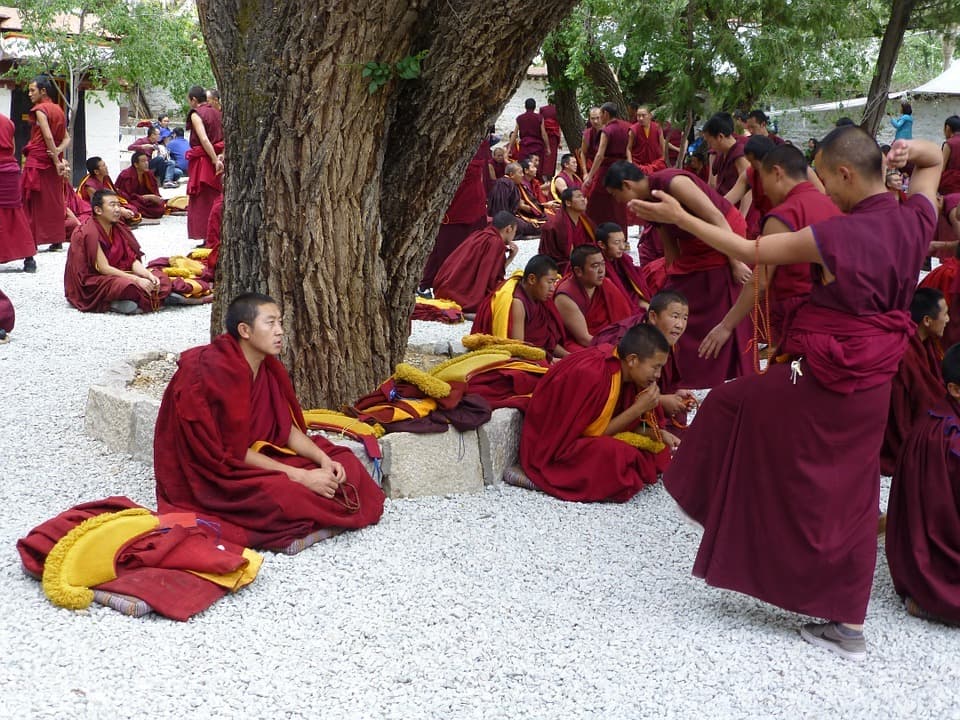
- The monks' debate in the philosophers' courtyard, mid-afternoon: a ritual of theatrical argumentation, punctuated by hand-clapping, which constitutes one of Tibet's most singular spectacles.
- Fresco restoration workshops, where painters meticulously recreate representations of celestial kings and other protective deities.
Compared to the Potala or Jokhang, Sera receives fewer tour groups and offers a more contemplative atmosphere, conducive to understanding how a Gelugpa monastery functions.
History of the Monastery
The monastery was founded in 1419 by Jamchen Chöjé Shakya Yeshe, one of the disciples of Tsongkhapa, founder of the Gelug branch of Tibetan Buddhism. It quickly established itself as a major center of philosophical studies, hosting at its height several thousand monks distributed among three colleges (Sera Me, Sera Je, and the tantric college Ngagpa).
Its history is marked by the upheavals of the twentieth century. The monastery was bombed and looted in 1947, then heavily damaged in 1959 during the suppression of the Lhasa uprising: several schools were destroyed and hundreds of monks lost their lives. In early 2008, approximately 550 monks still resided there. The disturbances that occurred in June 2008 led to a significant decrease in this community, and the number of permanent residents remains substantially reduced compared to the historical population.
What to See
The three colleges and the great assembly hall
The visit is organized around the three colleges and the Coqen, the great assembly hall. You will see statues of Tsongkhapa, Maitreya, and tutelary deities, as well as thangkas and sacred texts preserved in the libraries.
The monks' debate
In the inner courtyard of Sera Je, mid-afternoon (generally between 3 p.m. and 5 p.m.), approximately thirty monks engage in oratorical contests in pairs. One, standing, claps his hands before posing a doctrinal question; the other, seated, must respond. The hand-clapping, laughter, and sweeping gestures make the scene spectacular, even without understanding Tibetan. Photography is generally tolerated, but video may be prohibited: follow the posted instructions.
The fresco restoration workshop
In certain adjacent halls, painters work on restoring ancient frescos, notably the figures of the four celestial kings that adorn the entrances. This is a rare opportunity to observe the traditional techniques of Tibetan monastic painting.
Practical Information
- Opening hours: daytime opening, generally 9 a.m. to 4 p.m. These hours are indicative and may vary according to religious holidays and the season.
- Admission fee: entrance fee at a moderate rate, payable on site.
- Duration of visit: allow 1.5 to 2.5 hours, ideally planning your arrival to witness the monks' debate.
- Dress code: shoulders and knees covered. Remove hats and sunglasses when entering prayer halls.
- Permits: access to Tibet requires a specific permit in addition to your Chinese visa; it is obtained through an authorized agency.
How to Get There from Lhasa
The monastery is located approximately 5 km north of central Lhasa, at the foot of Tatipu Mountain.
- By taxi: the simplest option from the Barkhor or Potala quarter, allow around twenty minutes depending on traffic.
- By local bus: several lines serve the Sera quarter from the center, for a very low fare.
- With a guide: as part of an organized circuit in Tibet, transfers are usually included, which also facilitates explanations on site.
When to Visit
The best period runs from April to October, when Lhasa's climate is most favorable and mountain passes are accessible. The summer months (June to August) are the most crowded but also the wettest. Spring and early autumn offer a good compromise between stable weather and reasonable crowds. Winter, though more challenging, remains possible: the light is exceptional and Tibetan pilgrims numerous, but some connections may be disrupted.
To enjoy the monks' debate, plan your visit for the afternoon, knowing that it does not take place on Sundays nor during certain religious holidays.
Nearby
Sera is part of a range of major stops to combine during a stay in Lhasa and an extended circuit:
- The Ganden Monastery, second pillar of the "Big Three" Gelugpa, perched at altitude east of Lhasa.
- For those extending their journey toward Nepal, the Buddhist sites of the Kathmandu Valley such as Boudhanath and Swayambhunath offer a coherent continuation of the spiritual journey.
Frequently Asked Questions
Frequently asked questions
The debate generally takes place mid-afternoon, around 3 p.m. to 5 p.m., in the courtyard of Sera Je. It does not take place on Sundays or during certain religious holidays: check with your guide or at the monastery entrance.
Sera is located in Tibet, China, near Lhasa. It often appears in itineraries combining Népal with the Tibetan plateau, which explains its presence in guides linked to the Himalayan region.
A complete visit lasts between 1.5 and 2.5 hours, provided you arrive before the monks' debate to first tour the colleges and the great assembly hall.
Yes. Any trip to Tibet requires a Tibetan permit (TTP) in addition to your Chinese visa. It must be obtained through an authorized agency and presented at the monastery entrance.
Plan Your Trip
Sera Monastery naturally integrates into a circuit combining Kathmandu, Lhasa, and the Tibetan plateau. To build a tailor-made itinerary and obtain the necessary permits, consult our suggestions for travel to Népal and their extensions to Tibet.
Interested in this visit?
We can include it in your personalised itinerary.