Kalinchowk Temple
Kalinchowk Temple
Sanctuary dedicated to the goddess Kali, perched at 3,780 m in Dolakha district, at the end of a 7-8 hour trek from Charikot.
Kalinchowk Temple is a Hindu sanctuary perched at 3,780 meters altitude in Dolakha district, Népal, approximately 132 km from Kathmandu. Dedicated to the goddess Kali, it combines religious pilgrimage, mid-altitude trekking, and panoramic Himalayan views. It is accessed from the town of Charikot, the gateway to the Gaurishankar conservation area.
Why visit Kalinchowk Temple
Three elements make this attraction distinctive. First, it is a major pilgrimage site for Nepalese Hindus, linked to a specific mythological episode of the goddess Kali's battle against the demon Raktabija. Second, the summit ridge offers sweeping views of the Himalayan ranges: Annapurna, Manaslu, Ganesh Himal, Lamjung, Jugal Himal, Shisha Pangma and Gaurishankar unfold across the northern horizon. Finally, the access route crosses rhododendron forests and villages inhabited by Brahmin, Tamang and Sherpa ethnic groups, making it as much a cultural experience as a physical one.
History and legend of the sanctuary
The temple's foundation rests on a mythological narrative passed down by the sanctuary's priests. According to Hindu tradition, it was here that the goddess Kali confronted Raktabija, a demon that the other deities could not defeat: each drop of blood he shed on the ground spawned a new demon. Kali used her tongue to prevent the blood from touching the earth, but poisoned herself during the battle. Shiva then offered her blessed water from a mountain spring to relieve her.
This spring still exists on the site. Devotees drink from it today to receive Shiva's blessing. A persistent local belief holds that after visiting the temple, one should never return: the visit is meant to be accomplished only once in a lifetime.
Festivals celebrated here
Three major religious festivals mark the year at Kalinchowk: Janai Purnima, Dasai, and Chalte Dasai. They attract pilgrims from across the country and feature long processions. During these periods, crowds are substantial and the experience becomes primarily devotional.
What to see and do
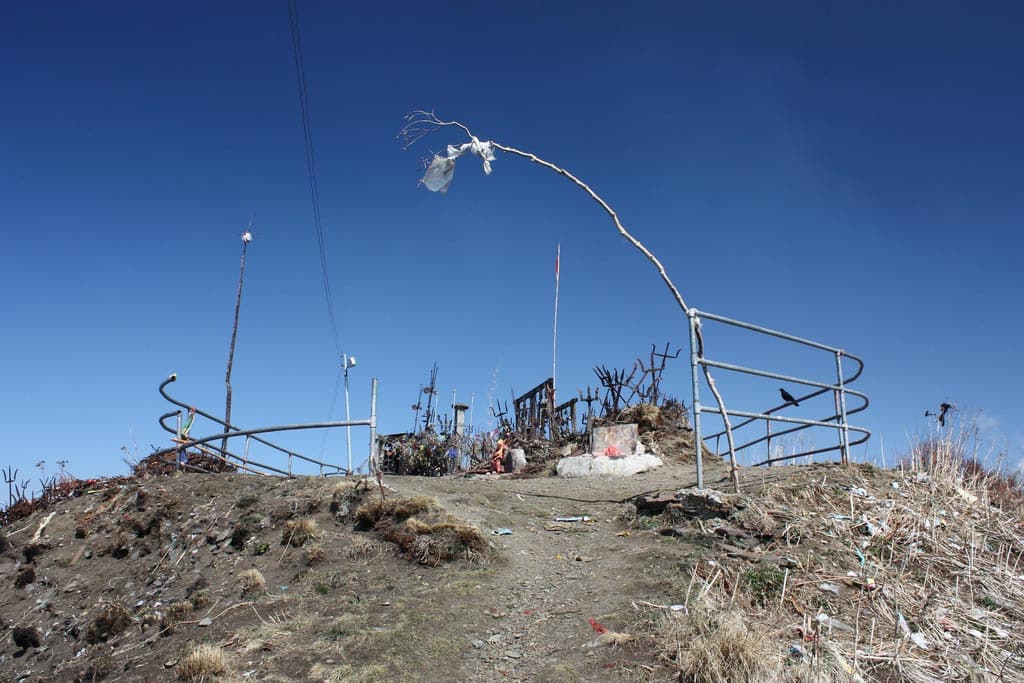
The temple itself is modest: a structure dedicated to Kali, surrounded by votive bells and prayer flags. The site's interest lies as much in the panorama as in the journey itself.
- Himalayan panorama: on clear days, you can identify Annapurna, Manaslu, Ganesh Himal, Lamjung, Jugal Himal, Shisha Pangma and Gaurishankar from the summit.
- Rhododendron forests: the route from Charikot crosses spectacular forest masses in spring, when the rhododendrons bloom.
- Villages along the way: Brahmins, Tamang and Sherpa coexist on the route, each with their typical houses and religious practices.
- Sacred spring: the spring linked to the legend remains accessible to pilgrims.
- Thuloptal: the last village before the temple, a usual stopping point to rest before the final ascent.
When to visit
The most appreciated period is spring (March to May), during rhododendron blooming. Temperatures are bearable at altitude and the sky remains relatively clear in the morning. Autumn (October-November) offers the best visibility conditions for the summits, after the monsoon clears the atmosphere.
From June to September, the monsoon makes trails muddy and slippery, and often obscures the panorama. In December-January, the summit is frequently snow-covered: the site becomes accessible but requires equipment suited to cold and snow. Avoid festival periods if you seek tranquility; prioritize them if you wish to experience the pilgrimage in full activity.
How to get there
The entry point is Charikot, the capital of Dolakha district. From Kathmandu, local buses depart daily to Charikot; allow a full day of travel given the condition of the tracks.
From Charikot, two options:
- Vehicle to Kuri, then approximately one hour of climbing on foot to the temple. This is the short option, accessible to most visitors.
- Full trek from Charikot, over 7 to 8 hours of walking. The route is technically easy but the final altitude (3,780 m) demands good physical condition and gradual acclimatization.
Practical information
- Altitude: 3,780 m. Plan for warm clothing even in dry season.
- Accommodation: small guesthouses in Charikot and simple lodges in Kuri. Moderate rates, reservation useful during high season and festivals.
- Dining: standard Nepalese cuisine (dal bhat, noodles, tea) in lodges. Low budget.
- Entry fee: a modest contribution may be requested during festivals.
- Equipment: hiking boots, windproof jacket, headlamp if you go up early for sunrise.
- Respect for the site: active sanctuary, proper attire required and discrete photography during ceremonies.
What to see nearby
Once in Charikot, several extensions are possible to other sites in the country. If you combine your trip with the Kathmandu valley, the Swayambhunath stupa and the historic city of Kirtipur are natural stops. For contrast with Kalinchowk's altitude, Begnas Lake, near Pokhara, offers a more relaxing lakeside stay.
Frequently asked questions
Frequently asked questions
Technically, yes: the trail is marked and has no difficult passages. But reaching 3,780 meters altitude requires good physical condition and gradual acclimatization. Novice hikers prefer the vehicle option to Kuri, then a one-hour final climb.
Spring (March-May) for rhododendron blooming and autumn (October-November) for summit visibility. Summer monsoon and snowy winter are best avoided unless you are properly equipped.
Allow a minimum of 2 to 3 days: one day's travel to Charikot, one day for the climb and temple visit, one day for the return. With the full trek from Charikot, add an extra day.
Yes, simple lodges exist in Kuri, the last hamlet accessible by vehicle. This allows you to go up to the temple early in the morning to enjoy sunrise over the Himalayas.
Visitor numbers vary. They are high during Janai Purnima, Dasai and Chalte Dasai, moderate in spring and autumn, low during monsoon and winter.
Planning your trip
Kalinchowk Temple fits well into an itinerary combining moderate trekking, cultural immersion and pilgrimage. To build a custom itinerary including Charikot and the Gaurishankar area, consult our Népal travel offer.
Interested in this visit?
We can include it in your personalised itinerary.