Jokhang Temple
Jokhang Temple
Tibet's principal Buddhist temple and the spiritual heart of Lhasa, Jokhang enshrines the revered statue of Jowo Shakyamuni and is recognized as a UNESCO World Heritage site.
Jokhang Temple, also known as Tsuklakang, is the first Buddhist temple built in Tibet and the spiritual heart of Lhasa. A pilgrimage destination for centuries, it holds a central place in Tibetan devotion and encapsulates more than thirteen centuries of religious history across a few thousand square meters.
Why Visit Jokhang Temple
Jokhang is far more than a monument: it is a living sanctuary. Each day, pilgrims from across the Tibetan plateau perform the kora, or circumambulation, around the temple, some prostrating themselves with every third step. This daily devotion makes the site a singular experience, quite unlike a museum visit.
The temple houses the most revered statue in Tibetan Buddhism, the Jowo Shakyamuni, representing Buddha at the age of twelve. Its architecture blends Indian, Nepali, Tibetan, and Tang-era Chinese influences—a rare testament to the cultural exchanges at the heart of the Himalayas.
Since 2000, Jokhang has been inscribed on the UNESCO World Heritage List as part of the "Historic Ensemble of the Potala Palace," alongside the Potala Palace itself and Norbulingka Park.
History of Jokhang Temple
Jokhang's foundation dates to the 7th century, during the reign of King Songtsen Gampo, considered Tibet's first unifying sovereign. According to tradition, the temple was built around 642 to house a Buddha statue brought by one of his wives, the Nepali princess Bhrikuti. A second statue, the Jowo Shakyamuni given by his Chinese wife, princess Wencheng, was later transferred here and remains to this day.
The building underwent successive expansions over the centuries, notably under the Fifth and Seventh Dalai Lamas. It survived turbulent periods, including the Cultural Revolution, which caused significant damage before lengthy restoration campaigns began in the 1980s.
The name Lhasa itself, meaning "place of the gods," is believed to derive from Jokhang's presence: the city gradually developed around the temple, rather than the other way around.
What to See at Jokhang Temple
The Barkhor and the Kora
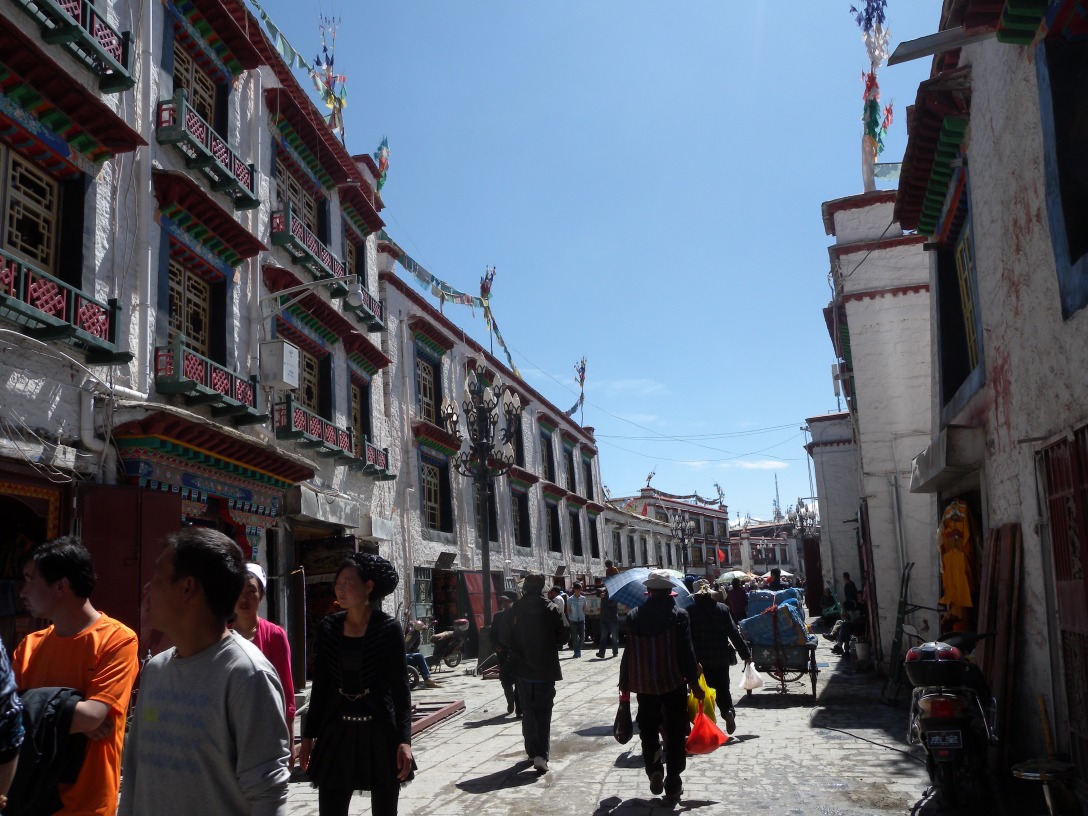
Before entering, the Barkhor circuit encircles the temple over approximately one kilometer. It is one of Lhasa's three major circumambulation routes, frequented from dawn to dusk by pilgrims. The adjoining lanes are lined with craft shops, ritual object stalls, and traditional houses.
The Main Hall and the Jowo Shakyamuni
At the temple's core, the central hall (Jokhang Lhakhang) enshrines the Jowo Shakyamuni statue, adorned with gold and precious stones offered by devotees. It is the most important object of veneration in Tibetan Buddhism: for many pilgrims, reaching this statue represents the culmination of a lifetime of practice.
The Side Chapels
The ground floor and upper levels contain a series of chapels dedicated to various deities, to Songtsen Gampo and his two wives, and to protectors of the Dharma. The wall paintings, some dating back centuries, deserve particular attention.
The Golden Roofs
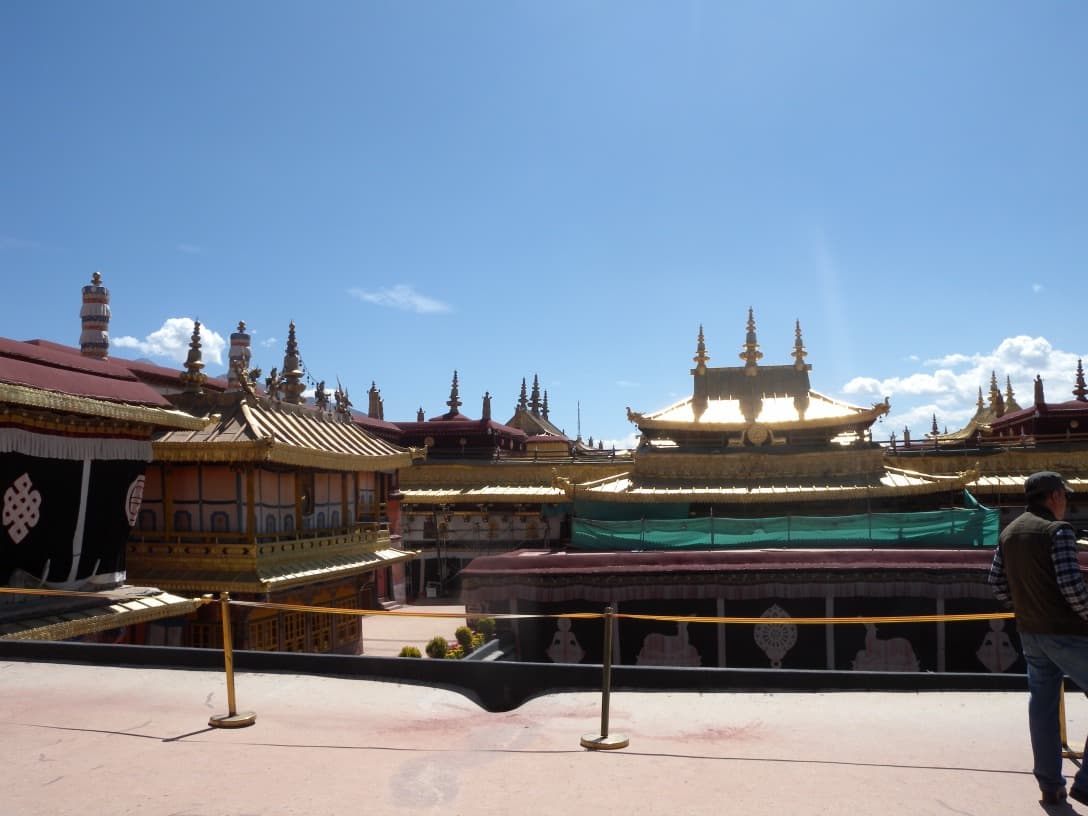
The terrace affords an unobstructed view of the temple's golden roofs, the Barkhor below, and the Potala Palace in the distance. It is one of Lhasa's most photographed vantage points, particularly in the late afternoon light.
Practical Information
- Duration: Allow 1.5 to 2.5 hours for the temple; longer if you take time for the kora and explore the Barkhor quarter.
- Admission: Modest entrance fee; free for Tibetan pilgrims, who make up most of the morning visitors.
- Dress code: Shoulders and legs covered; remove hats indoors. Photography generally prohibited in the chapels.
- Permit: Visiting Tibet requires a special Tibet Travel Permit in addition to a Chinese visa, arranged through an authorized agency.
- Altitude: Lhasa sits at 3,650 meters (11,975 feet). Plan two to three days for acclimatization before intensive sightseeing.
When to Visit Jokhang
The temple is open year-round, though conditions vary. April to June and September to October offer milder weather and often clear views of the Himalayas. July and August bring moderate rains to Lhasa, which remains relatively dry compared to Nepal.
To witness pilgrims' devotion at its best, arrive at opening time in the morning. Tibetan religious festivals, particularly Losar (Tibetan New Year, February–March) and Saga Dawa (May–June), draw spectacular crowds around the Barkhor.
Getting to Jokhang
The temple lies in central historic Lhasa, within the Barkhor quarter. From most old Lhasa hotels, it is walkable in 10 to 20 minutes. From the Chinese quarters farther west, taxis and local buses serve the Barkhor's edges; the final few hundred meters are on foot, as the area is pedestrian-only.
Lhasa is connected to the rest of China by air (Lhasa Gonggar Airport, roughly 60 km away) and by high-altitude rail from Xining, Beijing, or Chengdu.
Nearby Attractions
- Potala Palace: former seat of the Dalai Lama, about 20 minutes' walk to the northwest.
- Norbulingka Park: summer residence of the Dalai Lamas, west of the city.
- Sera Monastery: renowned for its monks' philosophical debates, approximately 5 km to the north.
Frequently asked questions
Yes. Access to Tibet, and therefore to Jokhang, requires a Tibet Travel Permit in addition to a Chinese visa. This permit can only be obtained through an authorized agency, which typically arranges the full itinerary on-site.
Allow approximately 1.5 to 2.5 hours for the temple itself. Adding the kora circuit around the Barkhor and a stroll through the quarter, set aside a half day.
Photography is generally forbidden in the interior chapels, particularly before the Jowo Shakyamuni. It is usually permitted in courtyards and on terraces, sometimes for an additional fee.
Lhasa sits at 3,650 meters, which may trigger mild altitude sickness. The temple visit, being physically undemanding, remains accessible if you allow two to three days for acclimatization upon arrival.
The morning, at opening, to witness pilgrims' devotion in the main hall. Late afternoon is ideal for light on the golden roofs as viewed from the terrace.
Planning Your Journey
Jokhang fits naturally into an itinerary combining Lhasa, the Potala Palace, and the region's major monasteries. To build a custom itinerary through Tibet and the Himalayas, explore our Nepal and Tibet journeys.
Interested in this visit?
We can include it in your personalised itinerary.