Gyantse Kumbum
Gyantse Kumbum
Built in the 15th century in Gyantse (Tibet), the Kumbum is a nine-level stupa housing over seventy chapels covered with Buddhist frescoes of remarkable preservation quality.
The Gyantse Kumbum is a multi-story stupa erected within the Pelkhor Chöde monastic complex in Gyantse, in the Tibet Autonomous Region. Constructed in the 15th century, it ranks among Tibet's best-preserved Buddhist monuments. Its three-dimensional mandala form, stacked chapels, and thousands of mural paintings make it an exceptional testament to classical Tibetan art.
Practical info at a glance
- Entrance: paid admission (ticket included in the Pelkhor Chöde complex)
- Recommended duration: 1.5 to 2 hours to explore the chapels in detail
- Dress code: modest dress required; shoulders and knees covered
- Access: Gyantse is accessible from Lhasa via the G318 national highway; a Tibet Travel Permit is mandatory for all foreign visitors
- Accessibility: upper floors are accessible only via narrow staircases; the ground floor is accessible
What to see
The Kumbum (literally "hundred thousand images") rises over nine levels and houses over seventy chapels. Each level corresponds to a stage of the Buddhist mandala. Interior walls are covered with vivid frescoes depicting deities, bodhisattvas, and cosmological scenes. At the summit, a gilded dome crowns the structure and offers a clear view over the Gyantse valley and the Dzong fortress.
History and context
The Kumbum was built between 1427 and 1436 at the initiative of local prince Rabten Kunzang Phagpa. It belongs to the Sakya school of Tibetan Buddhism, though the Pelkhor Chöde complex simultaneously housed several monastic traditions—a rare occurrence in Tibet. The monument largely survived the destructions of the Cultural Revolution, which explains the remarkable state of its original paintings.
Highlights of the visit
The painted chapels of the lower levels
The first four floors concentrate the most richly decorated chapels. The 15th-century frescoes blend Nepalese, Indian, and Tibetan influences. Take time to let your eyes adjust to the dimness before observing the details of the painted faces and mandalas.
The climb to the gilded dome
The steep and narrow interior staircases lead to the upper levels where chapels become smaller but equally decorated. The crowning dome, covered in gold leaf, is visible from much of the city.
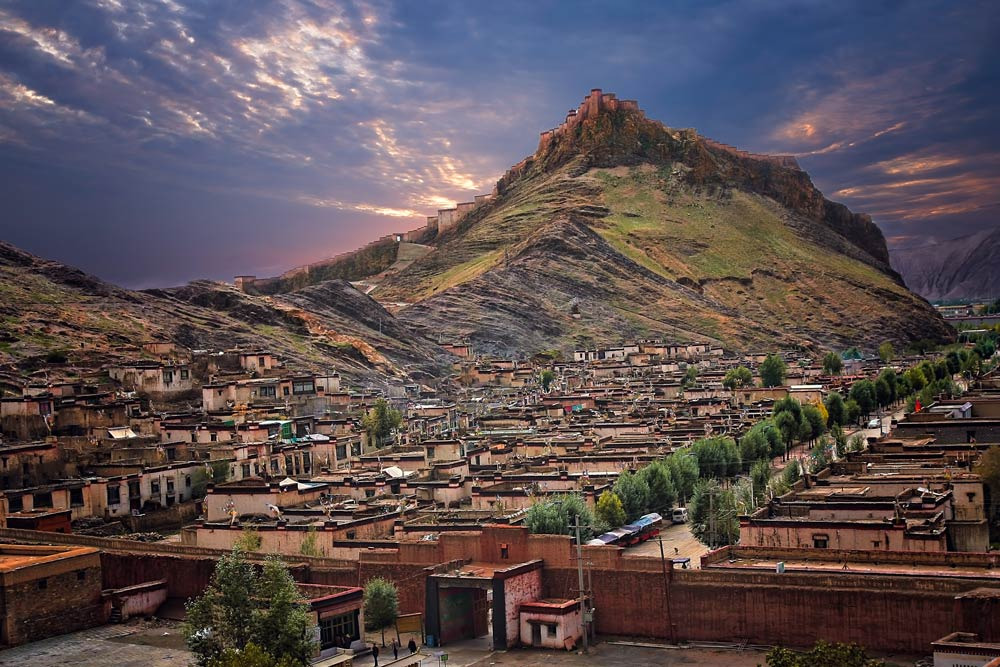
The view of Gyantse Dzong
From the external terraces of the upper floors, the Dzong fortress stands out against the rocky ridge that dominates the city. This panorama combines military and religious architecture in a typical Tibetan setting.
Etiquette and visiting rules
- Circumambulate the stupa clockwise (Buddhist circumambulation direction).
- Do not touch frescoes or statues.
- Ask permission before photographing monks or worshippers in prayer.
- Speak in hushed tones inside chapels.
- Remove your shoes before entering certain chapels (signs posted on site).
Photography tips
Natural light penetrates little into the interior chapels: a fast lens or high ISO sensitivity is essential. The exterior facade of the Kumbum is ideally lit in the morning, facing the rising sun. From the Pelkhor Chöde monastery courtyard, sufficient distance allows you to frame all nine levels. Photography is generally permitted inside for a small fee; check conditions on site.
Location and access
The Kumbum is located within the Pelkhor Chöde monastery grounds, in central Gyantse. The town sits approximately 260 km southwest of Lhasa on the Friendship Highway (G318), and about 90 km northeast of Shigatse. All foreign visitors must be accompanied by an approved guide and possess both a Tibet Travel Permit and an Alien Travel Permit for the Shigatse prefecture. No direct international public transport exists; access is by private vehicle organized from Lhasa or Shigatse.
Nearby attractions
- Gyantse Dzong — medieval fortress perched on a rocky spur overlooking the city, with a museum dedicated to Tibetan resistance in 1904.
- Tashilhunpo Monastery (Shigatse) — traditional seat of the Panchen Lamas, approximately 90 km away, one of Tibet's largest active monasteries.
- Yamdrok Lake — sacred lake with turquoise waters on the route between Lhasa and Gyantse, a must-see stop on the journey.
Frequently asked questions
Yes. Foreign visitors must obtain a Tibet Travel Permit (issued in Lhasa through an approved agency) and an Alien Travel Permit for the Shigatse prefecture. These documents must be obtained before departure through an approved local operator.
Allow between 1.5 and 2 hours to explore the chapels at your own pace. If you also visit the Pelkhor Chöde monastery and the Dzong, plan for a full half-day.
Upper floors are accessible via narrow and steep interior staircases. The climb is possible for most able-bodied visitors, but is not recommended for those with mobility issues or fear of heights.
Generally yes, for a small fee paid on site. Conditions may vary by chapel; respect prohibition signs and never photograph worshippers in prayer without their consent.
April through October offer the best weather conditions. Summer (June-August) is peak tourist season; spring and autumn allow for fewer crowds and favorable light for photography.
Gyantse Kumbum is located in Gyantse, in the Tibet Autonomous Region (China), not in Nepal. Travelers departing from Nepal can include it in a Tibet circuit by crossing the Gyirong border (Rasuwagadhi on the Nepalese side).
Interested in this visit?
We can include it in your personalised itinerary.