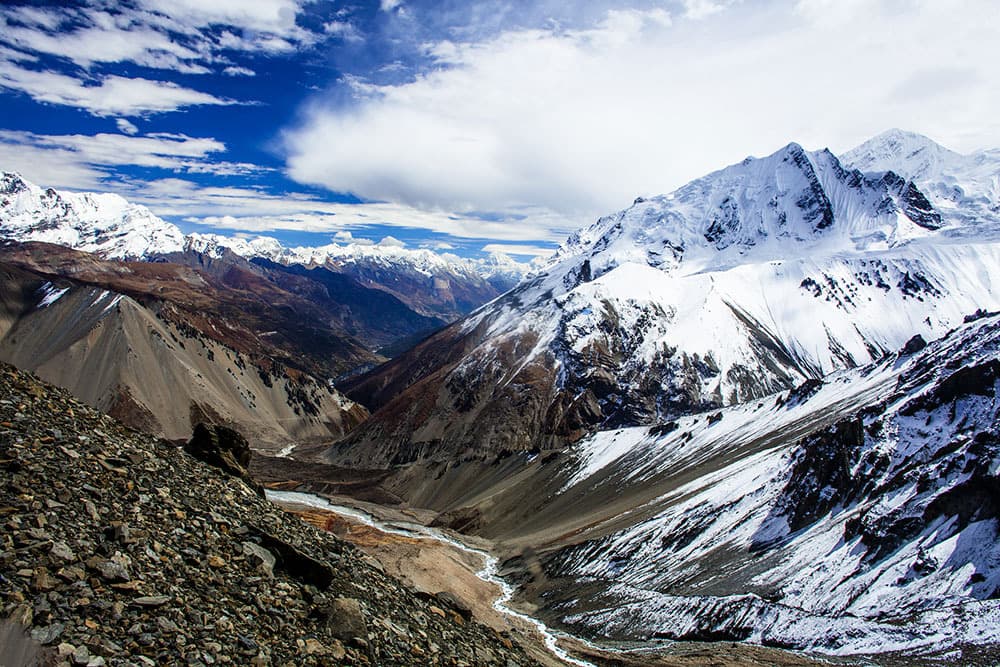
Thorung La Pass
Thorung La Pass
At 5,416 meters altitude, Thorung La Pass marks the culminating stage of the Annapurna Circuit, between the Manang Valley and Mustang District.
Thorung La Pass (Thorung Pass) peaks at 5,416 meters in the Damodar Himal range, north of the Annapurnas massif, in central Nepal. An emblematic high point of the Annapurna Circuit, it separates the verdant Manang Valley from the arid Mustang District. Access is exclusively on foot, after several days of trekking from Besisahar.
Why cross Thorung La Pass
Crossing Thorung La constitutes the culminating stage of the Annapurna Circuit, one of the most trekked routes in the Himalayas. Its appeal lies as much in crossing a pass above 5,400 meters as in the abrupt transition between two slopes: to the east, forests and terraced valleys of the Marsyangdi; to the west, mineral and desert landscapes announcing Mustang and the Tibetan plateau. This traverse concentrates, over a few days of trekking, several ecological zones of the central Himalayas.
History and commercial role
The pass has been used since at least the 15th century as a trade route between Manang and Mustang. Mustang then served as a relay for commerce with Tibet, and Thorung La connected caravans from the Marsyangdi basin to this network. Salt, wool, grain and manufactured goods circulated along these high-altitude trails. The route remains used by inhabitants of both slopes, though tourism has now largely supplanted commercial use.
What you'll see along the way
The typical crossing runs east to west, from Manang toward Muktinath. The route offers a succession of contrasting landscapes:
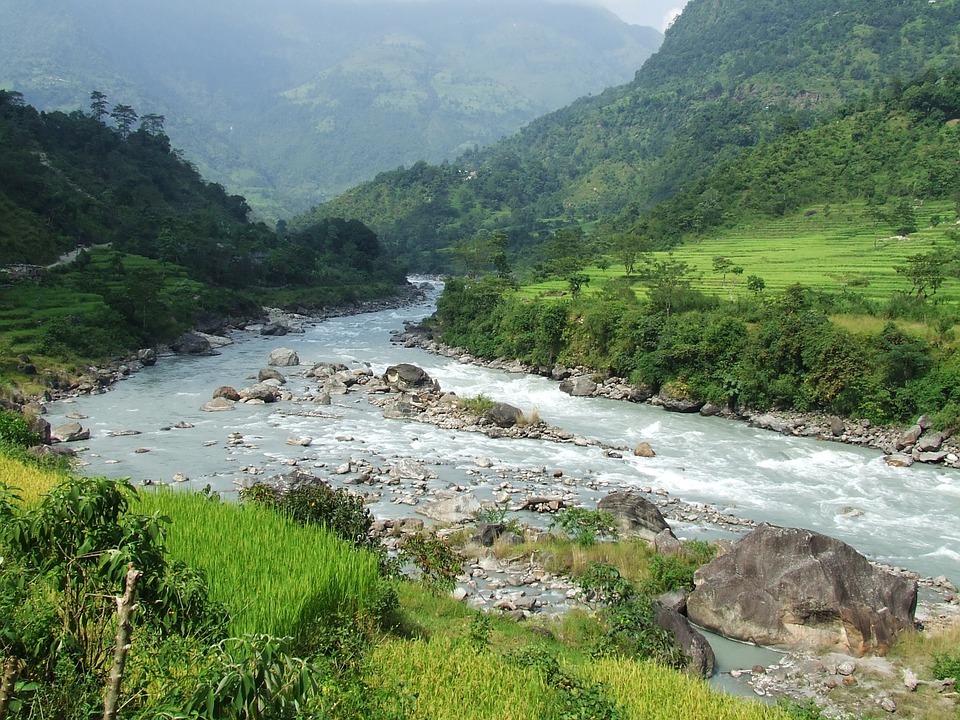
- subtropical forests and rice paddies in terraces around Besisahar;
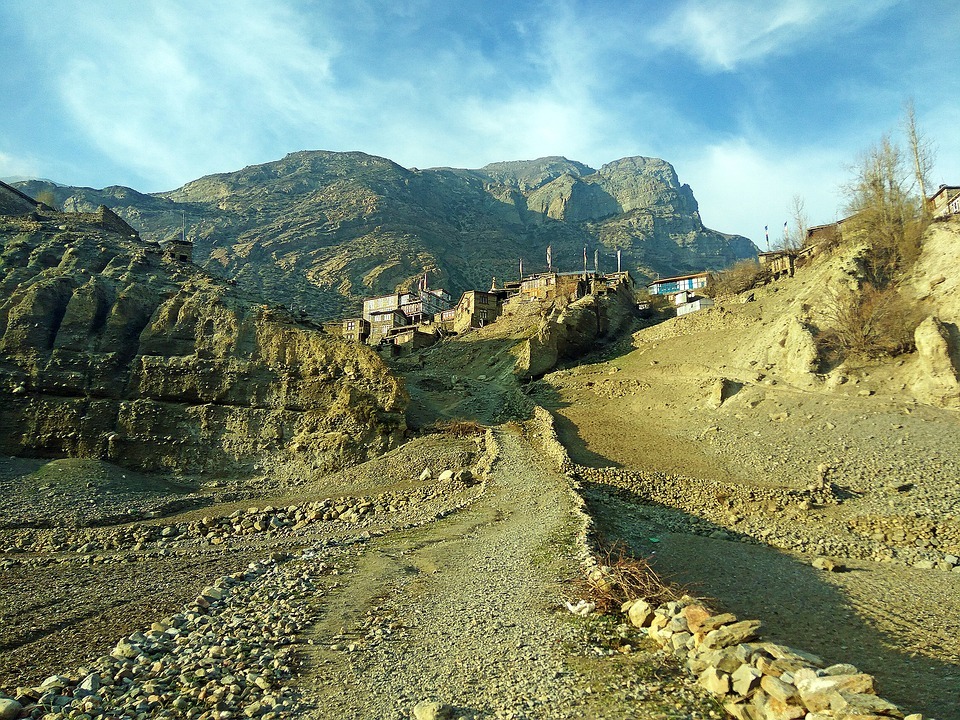
- Gurung and Manangis villages with stone houses, around Chame, Pisang and Manang;
- the high camp (Thorung High Camp) and the mineral ascent toward the pass, dominated by snow-capped peaks of the Damodar Himal;
- the vertiginous descent on the western side to Muktinath village, a Hindu and Buddhist pilgrimage site;
- the desert landscapes of lower Mustang, with ochre cliffs and Tibetan-speaking villages.
The pass itself is a windswept plateau, marked by prayer flags and a cairn signaling the altitude.
When to go
The favorable window extends from May to October, avoiding the height of monsoon season (July-August) on the eastern slope. The most stable periods are:
- April to early June: mild temperatures, rhododendrons in bloom on lower slopes;
- mid-September to November: clear skies, maximum visibility of peaks, but significant crowds.
From December to March, the pass is regularly snow-covered and sometimes impassable. Whenever the season, crossing the pass is done early in the morning to avoid violent winds that pick up midday.
How to get there
The classic starting point for the trek is Besisahar (around 800 m altitude), accessible from Kathmandu by public bus or private vehicle (allow a day's travel). From Besisahar, you reach on foot or by jeep the villages of Chame then Manang, before tackling the climb toward the pass. The descent ends at Muktinath, from where transport connects to Jomsom, then Pokhara by domestic flight or road. The complete circuit, as far as Pokhara, fits into classic Annapurna itineraries.
Practical information
- Permits: ACAP (Annapurna Conservation Area Project) permit and TIMS card mandatory, to be obtained in Kathmandu or Pokhara before departure.
- Level: demanding trek, without technical difficulty but long (12 to 18 days depending on itinerary) and involving high-altitude passage.
- Acclimatization: plan at least one rest day in Manang (3,540 m) before the climb. Acute mountain sickness is the primary cause of evacuation on this trek.
- Equipment: warm and windproof clothing for the pass, glacier glasses, lightweight crampons useful at the beginning or end of season.
- Accommodation: lodges (teahouses) throughout the route, rarer and more rustic above Manang.
What to combine in the region
The Annapurna Circuit fits naturally into a broader Nepal journey. Several complementary stages lend themselves to extension:
- Begnas Lake, near Pokhara, to decompress after the descent;
- Kirtipur, an ancient Newari city perched near Kathmandu, before or after the trek;
- Changu Narayan, one of the oldest temples in the Kathmandu Valley.
Frequently asked questions
Frequently asked questions
Plan your trip
Crossing Thorung La is organized as part of a complete Annapurna Circuit trek, with acclimatization, permit logistics and local support. To build an itinerary including this pass and other sites in the country, consult our Nepal trips.
Interested in this visit?
We can include it in your personalised itinerary.
