Barkhor
Barkhor
A one-kilometre circumambulation route encircling Jokhang Temple, the Barkhor is at once a Buddhist kora, a vibrant marketplace and a historic quarter of Lhasa.
The Barkhor is the circumambulation route that encircles Jokhang Temple, at the heart of Lhasa's old city. Stretching approximately one kilometre, this "middle circuit" embodies three dimensions at once: a Buddhist ritual pathway, a bustling commercial artery, and one of the most beautifully preserved historic quarters on the Tibetan plateau.
Why visit the Barkhor
The Barkhor concentrates three essential dimensions of Tibetan culture within a few hundred metres. First and foremost, it is a major kora, traversed daily by pilgrims in a clockwise direction, prayer wheel in hand. It is also a neighbourhood marketplace where ritual objects, textiles, teas and artisanal wares are exchanged. Finally, it is an urban ensemble of former residences of the Tibetan nobility, bearing witness to a social and religious order that predates the twentieth century.
For the visitor, the appeal lies in this rare superposition: an active sacred site, frequented by the faithful, rather than a frozen backdrop for tourism.
History and significance of the kora
The creation of the Barkhor is tied to that of Jokhang Temple, founded in the seventh century under the reign of King Songtsen Gampo. From the moment the first pilgrims arrived to venerate the statue of Jowo Shakyamuni enshrined within the temple, a circumambulation path traced itself around the sanctuary, consolidating over the centuries.
The quarter that formed around this circuit came to house aristocratic residences, hostels for pilgrims from across the Tibetan world, as well as shops and merchants. At the four cardinal points of the circuit stood four great incense burners, the sangkangs, where incense burned continuously to appease the protective deities guarding the Jokhang. Some of these burners remain today and still mark the symbolic corners of the route.
The Barkhor also served as the stage for Lhasa's political and religious life, hosting processions, liturgical festivals and major gatherings during Tibetan New Year (Losar) or Monlam.
What to see and do on the Barkhor
The circumambulation circuit
The full circuit is completed on foot, in clockwise direction, following the flow of pilgrims. Allow approximately one hour to complete the kora at a contemplative pace, longer if you stop at shops or secondary chapels.
Jokhang Temple
At the centre of this sacred landscape stands the Jokhang Temple, the most sacred sanctuary of Tibetan Buddhism. A visit to it complements the Barkhor experience: the kora reveals its deeper meaning once you understand what it encircles.
Traditional houses and former aristocratic residences
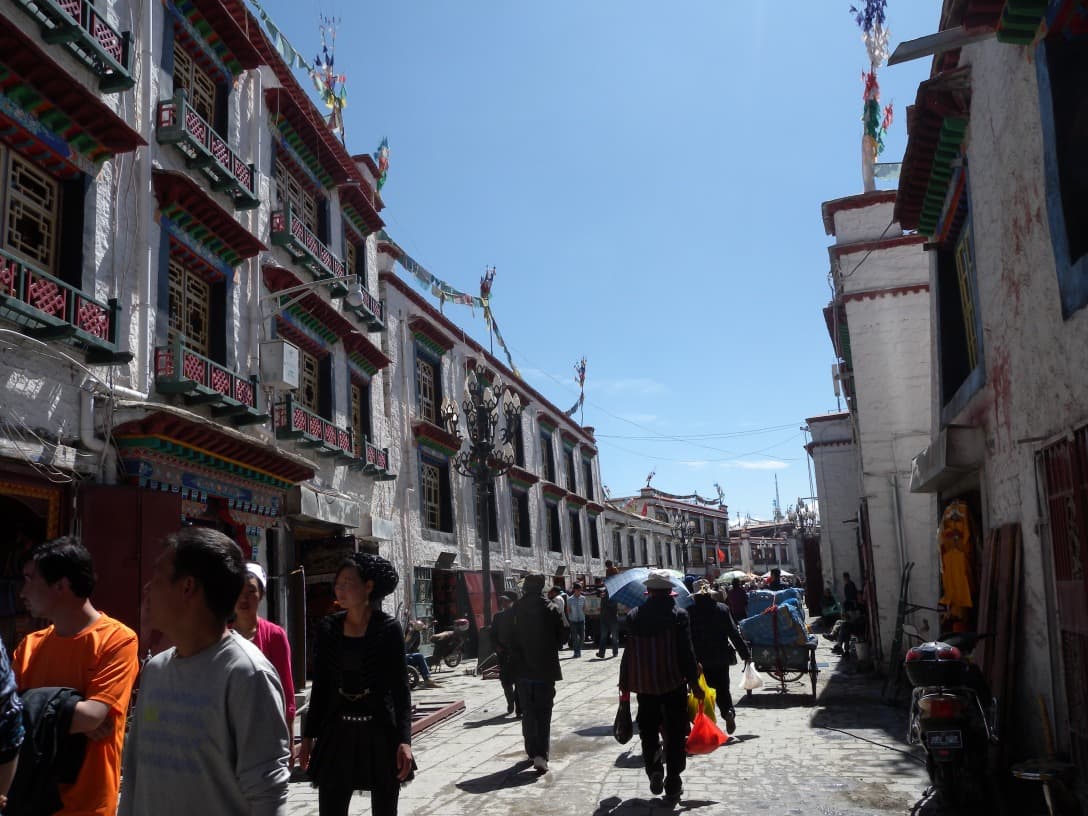
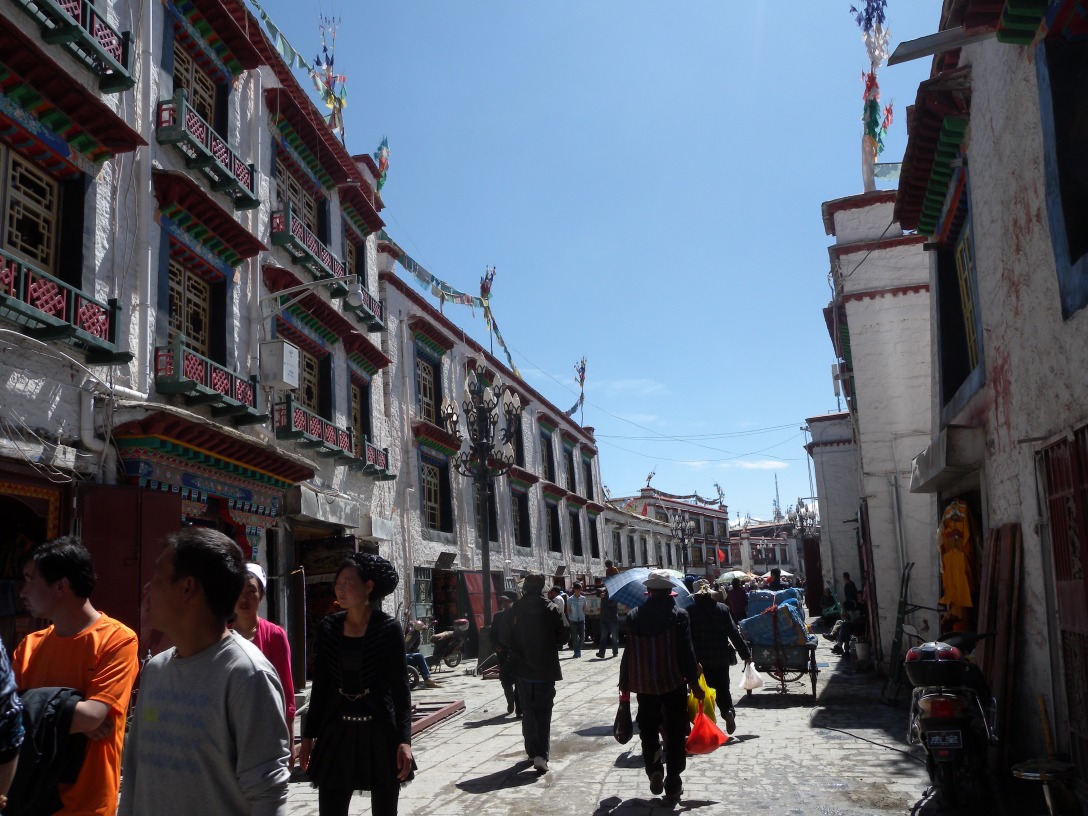
Along the circuit, several ancient buildings survive, identifiable by their whitewashed facades, dark-framed windows and cloth awnings. Some former homes of Tibetan nobility have been converted into museums, artisan workshops or tea houses.
The sangkangs and ritual details
Spot the cardinal incense burners, rows of prayer wheels to be turned in passing, and pilgrims performing full-length prostrations on the stones. These gestures punctuate the quarter from morning to evening.
The Barkhor marketplace
The lanes that run alongside and cross the main circuit form a thriving market: religious objects (prayer flags, singing bowls, statuettes), silver and turquoise jewellery, textiles, pressed tea, ritual supplies. Bargaining is customary.
Practical information
- Location: Lhasa's historic centre, around Jokhang Temple.
- Access: the quarter is pedestrianised; entry is through several monitored gates.
- Duration of visit: allow 1 to 2 hours for the kora and wandering through the lanes, a half-day if you combine with Jokhang.
- Cost: access to the Barkhor itself is free; only entry to the interior of Jokhang is ticketed.
- Direction of circulation: always clockwise, out of respect for the ritual.
- Altitude: approximately 3,650 metres. Plan for acclimatisation time in Lhasa before any extended walking.
- Permits: entry to Tibet requires a special permit in addition to a Chinese visa, to be arranged in advance through an agency.
Photography is tolerated in the public spaces of the Barkhor, but should be avoided inside chapels and in the presence of officials. Dress conservatively, with shoulders and legs covered.
When to visit
The Barkhor can be explored year-round, though conditions vary considerably by season. From April to October, the climate is milder and daylight hours longer, corresponding to peak visiting season. From November to March, the quarter is quieter, frequented almost exclusively by pilgrims, but nights are cold and the altitude is more keenly felt.
The high points of the religious calendar—Losar (Tibetan New Year, February-March) and Saga Dawa (May-June)—transform the Barkhor into a theatre of dense processions: deeply rewarding to witness, though expect crowds.
For the most authentic atmosphere, visit early morning, when pilgrims undertake their first kora of the day.
Nearby
The Barkhor is part of a broader exploration of Lhasa and the region. Combine it with the Jokhang Temple at the centre of the circuit, and more widely with discovering Lhasa and its great monasteries. For travellers continuing into neighbouring Nepal, Bhaktapur Durbar Square and Changu Narayan offer an intriguing counterpoint to the Newar culture of the Kathmandu Valley.
Planning your journey
The Barkhor is best experienced as part of a journey combining Tibet and the Himalayan region, subject to specific formalities. To craft a bespoke itinerary incorporating Lhasa, its koras and Nepali valleys, consult our journeys to Nepal and the Himalayas.
Interested in this visit?
We can include it in your personalised itinerary.